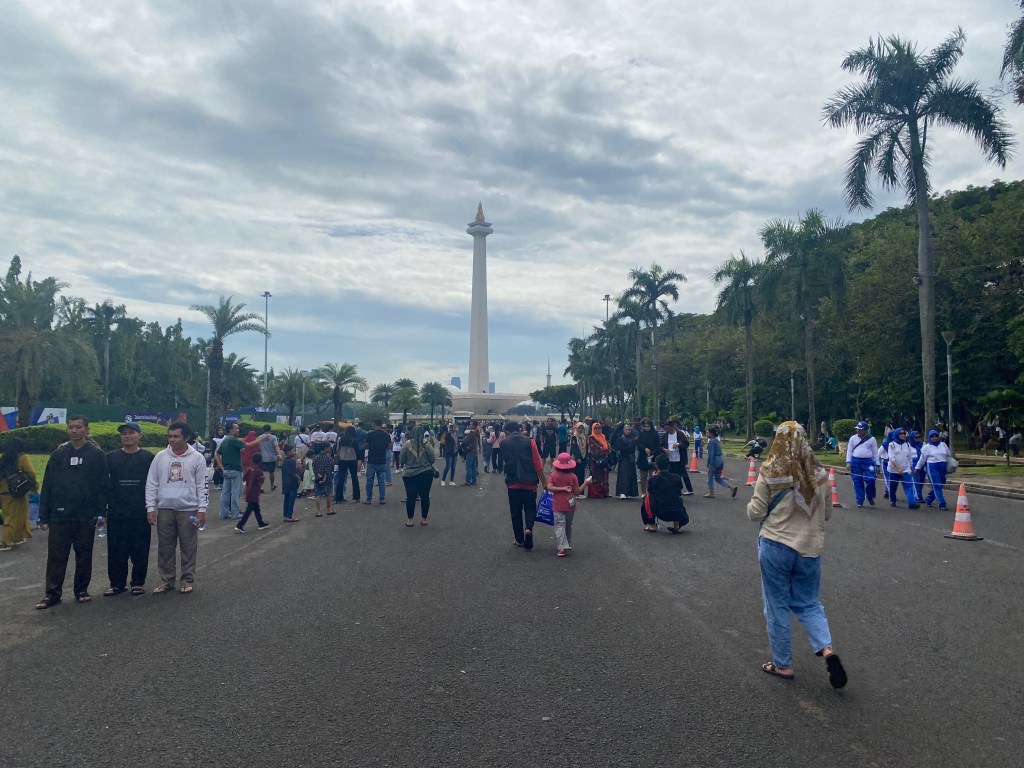
Greetings from Jakarta! I am in Indonesia for the briefest of long-haul trips—on the ground for six days, down to the hour—to work at the AAS-in-Asia conference this week. I arrived Saturday afternoon and will leave for the conference in Yogyakarta tomorrow morning, giving me one free day for some quick tourism.
I walked around Jakarta for hours today and have a boatload of thoughts, notes, and photos to organize. For now, just this: I’m genuinely surprised at the number of New York Yankees baseball caps I saw people wearing. I’d love to read something on the global circulation and cultural capital of that NY symbol.
Also, fellow Phillies fans, we have some serious ground to make up on the international scene.
I know that’s the kind of thoughtful, penetrating analysis you all come here for every week. Thank you for indulging my jet-lagged, sun-ripened brain. On to links, which are somewhat light this week due to the July 4 holiday in the U.S. and my own pre-departure preparations. Thanks for reading.
Recommendations
China Stories
Thomas Chen, “The Lie of the Land: June Fourth, Censorship, and ‘On the Edge’”
Ramin Ganeshram, “How a Cake Became a National Obsession”
Jazper Lu, “China Reopened to Foreign Students. Americans Are Staying Away.”
Luo Yahan and Wang Jingyang, “Up or Out: The Ruthless Tenure Race for Young Chinese Scholars”
What makes Liu Xiaobo such an interesting thinker, writer and dissident was his constant state of intellectual ferment. While he held firmly to his core principles — justice, fairness, openness, liberty — the hardship and imprisonment he endured seemed to soften rather than harden him. The more repression he suffered, the more self-reflective he became. One of Liu’s most distinguishing hallmarks was the need to confront wrongdoing and mendaciousness wherever he found it, even within himself. “The only route to liberating the spirit,” he once wrote, “is to repent and hold oneself responsible” — exactly what he saw Chinese leaders as almost congenitally indisposed to doing.
—Orville Schell, “The Martyrdom of Liu Xiaobo”
Lokman Tsui, “Being in exile is to struggle to say ‘here’”
Wanderings Around the World
Lindsay M. Chervinsky, “From Abigail Adams to Jill Biden, We’ve Been Arguing about First Ladies since 1787”
Sohini Desai, “Overexposed: What happened to privacy when Americans gained easy access to cameras in the Gilded Age?”
Pallab Ghosh, “World’s oldest cave art found showing humans and pig”
Jaya Saxena, “How to Feed the Olympics — Step one: Get 3 million bananas”
Andrew Stokols, “Khon Kaen, Thailand: local development amidst infrastructural geopolitics”
John Yoon, Hisako Ueno, and Kiuko Notoya, “Japan Finally Phases Out Floppy Disks”
Standout Story
There is no equivalence between the Trinity test and the annihilation of Hiroshima and Nagasaki, where nuclear blasts killed between 110,000 and 210,000 people, mostly civilians, and caused illness in others, whose families have also not received an apology or reparations from the U.S. government. But that takes nothing away from the Trinity Downwinders’ fight for recognition. These histories, in fact, are intertwined, as the refusal to acknowledge domestic harms emerged from the political imperative to minimize deaths and radiation in Japan. Both involve a failure — a refusal — to see clearly and atone for the legacies of the Manhattan Project.
—Nora Wendl, “Trinity Fallout”
Featured photo: Approaching the Monumen Nasional (National Monument) in Jakarta’s Merdeka Square, July 7, 2024.


Leave a Reply