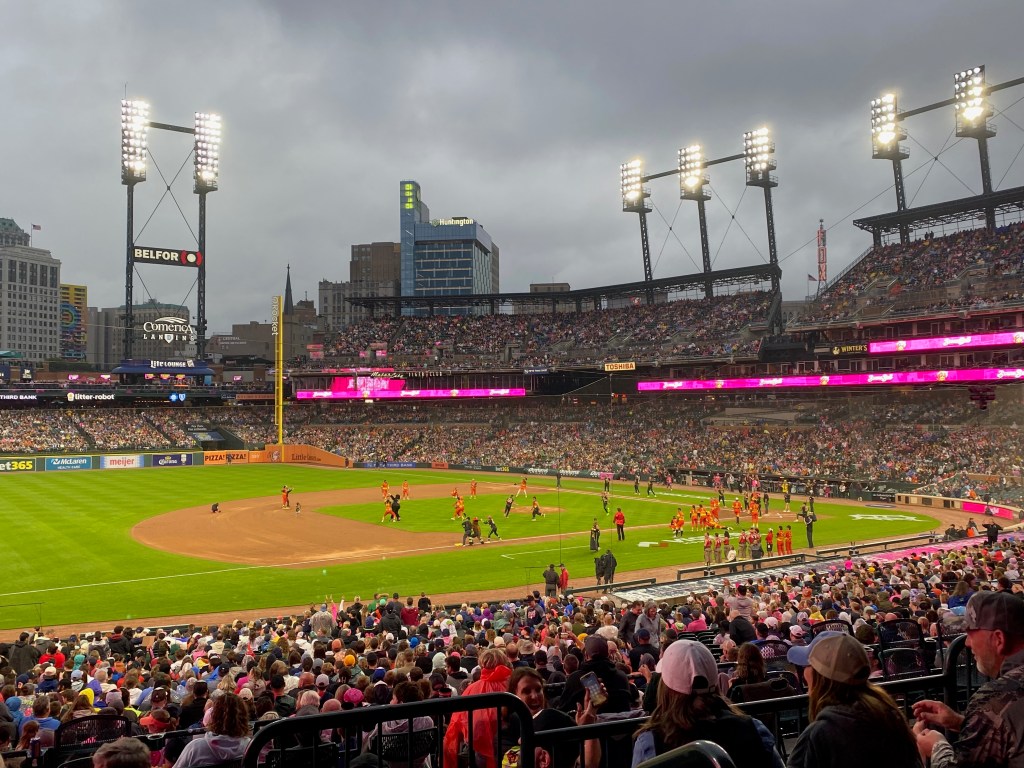
Play (Banana) Ball
Both a legitimate ballgame with double plays and home runs and the daffiest outdoor musical you’ve ever seen, Banana Ball is a judgment-free Xanadu where the umpire dances, the pitcher sings, the pinch hitter straps on stilts, and a family can have a pleasant night out without securing a second mortgage. — Jason Gay, with photographs by Lukas Wassmann, “The Unlikely Rebels Who Saved Baseball from Being Boring”
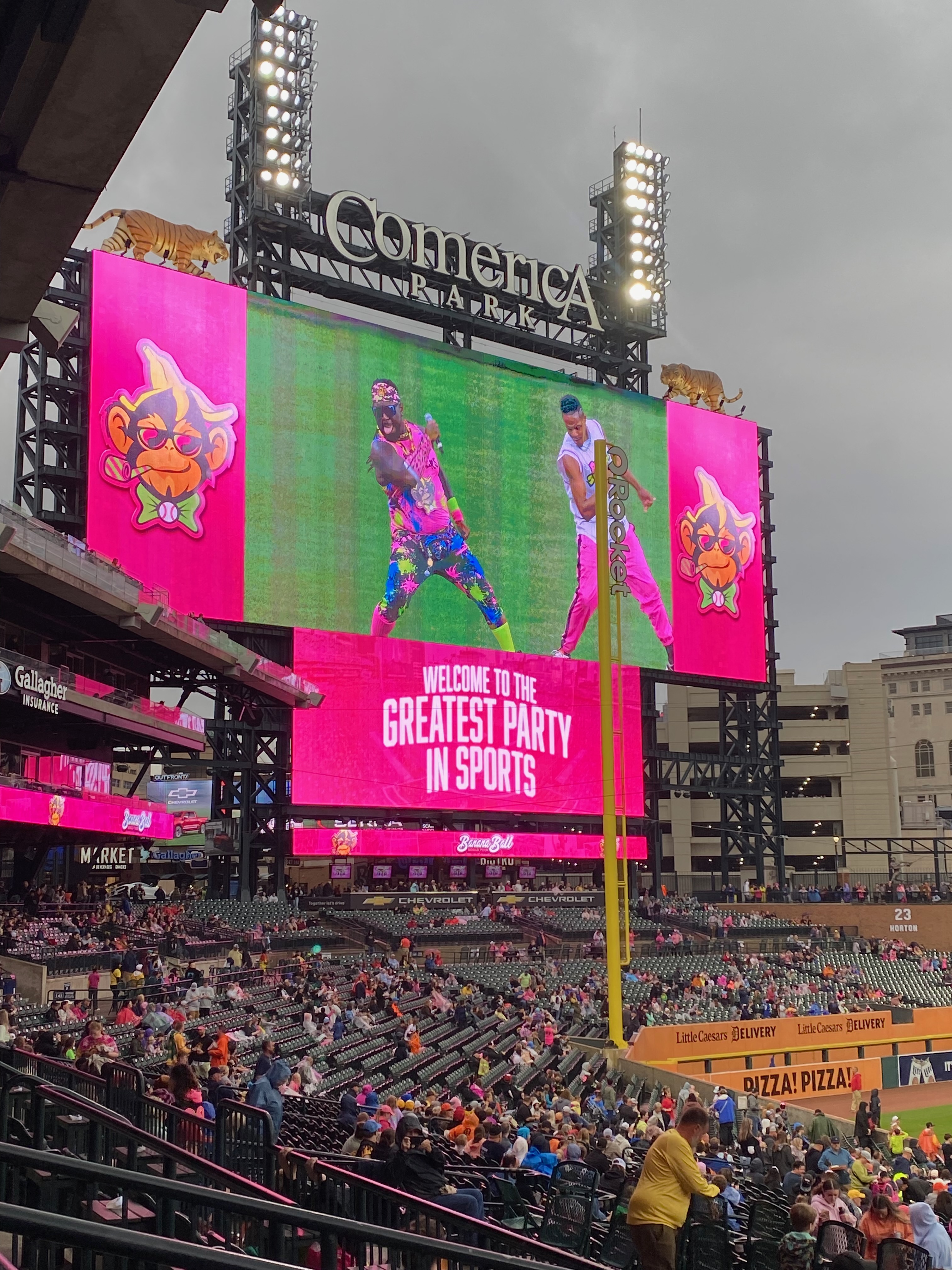
I didn’t even know there were going to be late-September Banana Ball games in Detroit until a friend won four tickets in the lottery and offered one to me. Since I’ve never found baseball boring, the idea of amping up a match with singing and dancing hadn’t previously seized my interest. Still, I’d heard that Banana Ball is a good time, and I’m always up for a baseball game, whatever the style.
The style, I quickly realized, was a somewhat weird but captivating mashup of Little League baseball and a Magic Mike-inspired revue. Players were introduced with their Instagram and TikTok handles, and I often wondered if they were athletically-inclined aspiring Broadway stars, or competent athletes who also happened to have stage skills. As the above article by Jason Gay indicates, it’s a little bit of both.
How much of the game itself did I watch? Not a whole lot. I was more interested in the band performing on the sidelines, the pitchers walking along the bullpen fence like a balance beam, the mascot sitting on an inflatable couch in the outfield, and the other entertainment acts. Just over a month later, I can’t even remember which team won. What I do remember is this: as Gay notes, “a recent series between the Party Animals and the Firefighters at Comerica Park in Detroit attracted 41,000 people on consecutive nights. (The hometown Tigers draw about 28,000.)” Not mentioned is that on the Saturday night I was there, it rained, lightly but steadily, for almost all of the game. Fans donned ponchos but never left. The players/entertainers seemed completely immune to the precipitation. After all, the show—and the game—must go on.
Thanks for joining me this week. 🍌⚾️
Recommendations
China Stories
Micro-drama is indeed exporting a business model. But behind the model lies something else: a delivery system for engineered catharsis, served fast. The powerless rescued by the powerful, the poor lifted by the rich, grievances answered with satisfying speed. And such catharsis is never ideologically neutral. — Shirley Xinyi Cai, “Exporting the Micro-Drama Machine”
David Frazier, “Eileen Chang’s ‘Lovable Yet Miserable Times’”
Howard W. French, “Let a Hundred Websites Bloom”
Andrew Higgins, “Where Every Tree Hides ‘an Enemy’: How I Watched China’s Paranoia Grow”
Lew-Williams’ purpose in this book is to explore how the Chinese made an existence in the United States even as expulsions and anti-Chinese laws flourished. She coins the term “conditional inclusion” to describe early Chinese status in America, writing that “most local racial laws were not devised to exclude and expel. They were designed to control.” Through deep research into municipal and state archives in the American West, Lew-Williams discovers that more than 5,000 laws were created to limit Chinese activity and rights.— Jen Lin-Liu, “Nothing to Their Name” — a review of John Doe Chinaman by Beth Lew-Williams, which just won the Cundill History Prize
Hannah Miao, with photographs by Gilles Sabrié, “China’s Weakening Economy Is Creating a Lost Generation”
Carl Minzner, “China’s Long Twilight: Demographic Decline, Political Paralysis, and the Fate of Great Powers” — preview of Minzner’s forthcoming book, As China Ages: The Politics of Demographic Decline in the Counter-Reform Era, which is coming out in December
Zubayra Shamseden and Peter Irwin, “The Global Cost of Ignoring Xinjiang”
Of all the successes in Xinjiang over the last 75 years none may be as remarkable as the latest: The Chinese are growing fish in Xinjiang, a place often referred to as the most landlocked spot on the planet. — Ian Urbina, “Xinjiang’s ‘Blue Miracle’”
Wanderings Around the World
Blair Braverman, with photographs by Delaney Allen, “Steffen Skjottelvik wanted to follow in the footsteps of Norway’s great adventurers. He planned a multiyear trek through rivers, forests and snow in the Canadian wilderness. Only his sled dogs returned.”
Robert Lester, “A Long (Long) Walk Down the Ambler Road”
Standout Story
I picked a fun one this week:
Ysabel Yates, “Cookie Monster Tries to Meet His A.I. Mandate”
Featured photo: Banana Ball game between the Party Animals and Firefighters at Comerica Park in Detroit, September 19, 2026.


Leave a Reply