
Thanks for joining me this week. 🎼
RIP Dolly Parton
Rahawa Haile, “Dolly Parton Loved Being Dolly Parton”
Tressie McMillan Cottom, “The Greatest Story Dolly Parton Ever Wrote Was Herself”
John Nichols, “Dolly Parton Was a Proud Union Sister”
Kathryn Schulz, “Dolly Parton for the People”
Latest Writing
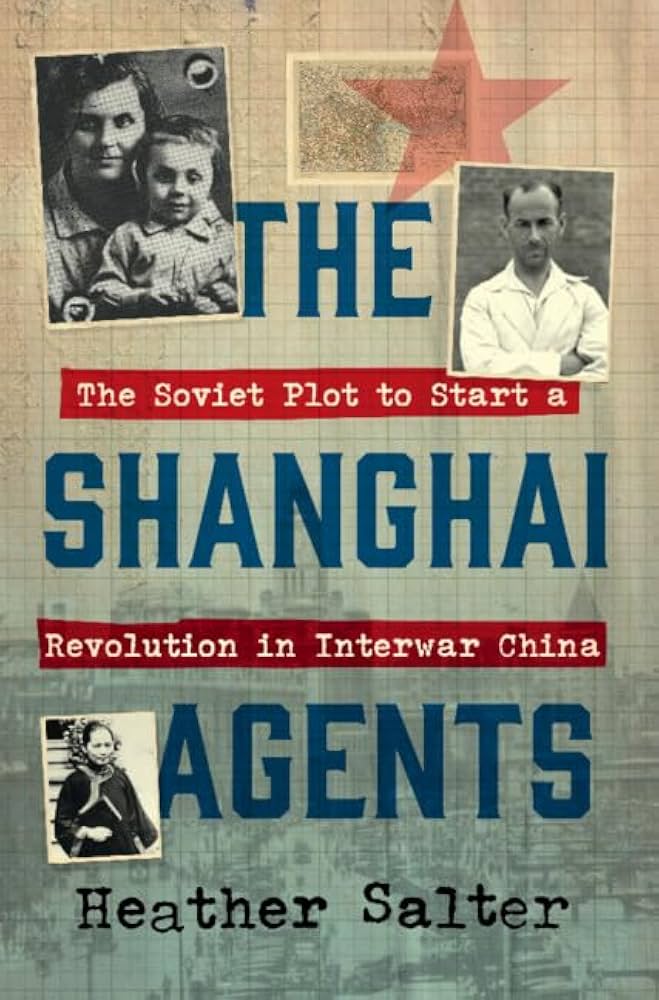
I have a new Wall Street Journal book review up, about The Shanghai Agents: The Soviet Plot to Start a Revolution in Interwar China, by historian Heather Salter:
No one knew the real names of the defendants. When the Shanghai Municipal Police arrested them for suspected communist activities on June 15, 1931, the pair identified themselves as the Belgians Hilaire Noulens and Marie Motte—no, it was Fernand and Marie Vandercruyssen. Later that summer they told British colonial authorities that they were actually Swiss and named Beuret. In November the story changed yet again; they were still Swiss, but now Paul and Gertrud Ruegg.
None of the identities stuck, as both Belgian and Swiss authorities quickly disproved the pair’s claims to citizenship. Unable to secure the legal protection of extraterritoriality offered to certain foreign residents in China, the “Rueggs” were turned over to the Chinese Nationalist government for a trial that had a chance to result in their execution. The couple certainly couldn’t admit who they really were: Yakob Rudnik and Tatyana Moiseenko, undercover Soviet agents for the Communist International, or Comintern. READ MORE (gift link)
Recommendations
China Stories
There’s something about found photography, about vernacular photography, that is completely crazy: Quantity is more important than quality. You need quantity to make the switch from personal memory to collective memory. That’s how you end up with a gigantic photo album. It’s not the album of a family. It’s the album of a city, a generation, a place, and a time. — Thomas Sauvin, speaking to Cai Yineng, “China Before the Infinite Camera Roll”
Chen Caiwei, “A Chinese Podcaster Interviewed Christopher Nolan. Here’s Why it Made Two Internets Freak Out.”
Julian Gewirtz, “Xi Jinping Hits the Road”
It may be hard to make money in China in 2026, but it is very pleasant to spend it. A major element of involution is the brutal competition in every market that puts downward pressure on prices as consumers, spoiled for choice, demand higher and higher quality. Hotels, trains, flights, food, clothes, cars, phones, electronics, massages, mountaineering gear, Labubus: all are cheap compared to the United States. — Jeremy Goldkorn, “App Life in China: Notes on a Long-Delayed Return to China”
Lucy Hornby, “When Wen Jiabao Fought the Quake Lake”
Xiong Zhiying, “Underground No More: China’s ‘History Fangirls’ Stand Up”
Zeyi Yang, “The Unlikely Place at the Center of China’s AI Boom”
Wanderings Around the World
Lorcan Lovett, “‘Forget about going back’: 9 years on, Rohingya crisis enters dangerous phase”
The flood did not only take the village. It took the road to the district headquarters, and with it, the road to the rest of the country. The market that fed us is gone, which means there is nowhere left to buy anything. The fields we planted are gone. And even the grain that families still have stored at home is grain they can no longer mill into rice or flour, because the mills are gone too. — Arjun Poudel, “I Watched My Village Disappear in an Instant”
Featured photo: Great Smoky Mountains of Sevier County, Tennessee in 2007, photographed by Wikimedia Commons user Aviator31 and released into the public domain.


Leave a Reply