
I gazed at the sheet of paper in my hand, trying to convey intense fascination with the picture of a panda printed on it. I fought the urge to flick my eyes to the right, to acknowledge the presence of Chris, the cameraperson who hovered in my peripheral vision. Instead, I kept my sight trained on the panda and fought to arrange my face into an expression that conveyed something approximating “studious and smart,” even though I felt anything but by that point on Saturday afternoon. What seemed like five minutes (but was probably thirty seconds) passed before I heard the calm voice of the producer, Allister, say, “Okay, good”—my signal to relax before we would start again.
I spent the entirety of Saturday working with Chris and Allister, who arrived at my house early in the morning to film me talking about the history of panda exhibitions and panda diplomacy. This all came about after I received a message on Instagram in early January from Hui Huan, a journalist with Channel News Asia in Singapore, who had read a blog post I wrote back in 2016 about the history of pandas at the Bronx Zoo. Hui Huan has been working on a documentary about panda diplomacy, and she wanted to bring me in as one of the talking heads giving historical background. Her colleague in the U.S., Allister, would be in touch soon to discuss the logistics.
Assuming that this would all take place over Zoom—what media organization has money for anything else these days??—I agreed. An email from Allister upended my assumptions: based in Washington, D.C., he would fly to Detroit and meet up with a cameraperson, then the two of them would come to my house in Ann Arbor for filming.
😳😳😳
I’m comfortable with public speaking, and I’ve done plenty of interviews—I was confident in my ability to handle the content side of the equation. But … real filming, not just on Zoom? Yikes. I scheduled a haircut, started deep-cleaning my house, and dove into my closet to figure out what I should wear.
Hui Huan and Allister provided me with a list of questions and topics to prepare, and we had a pre-meeting over Zoom to review my talking points. In total, I had about an hour of material to cover, but Allister asked me to clear a full day for filming, explaining that a significant amount of that time would be devoted to setting up in various locations around my house.
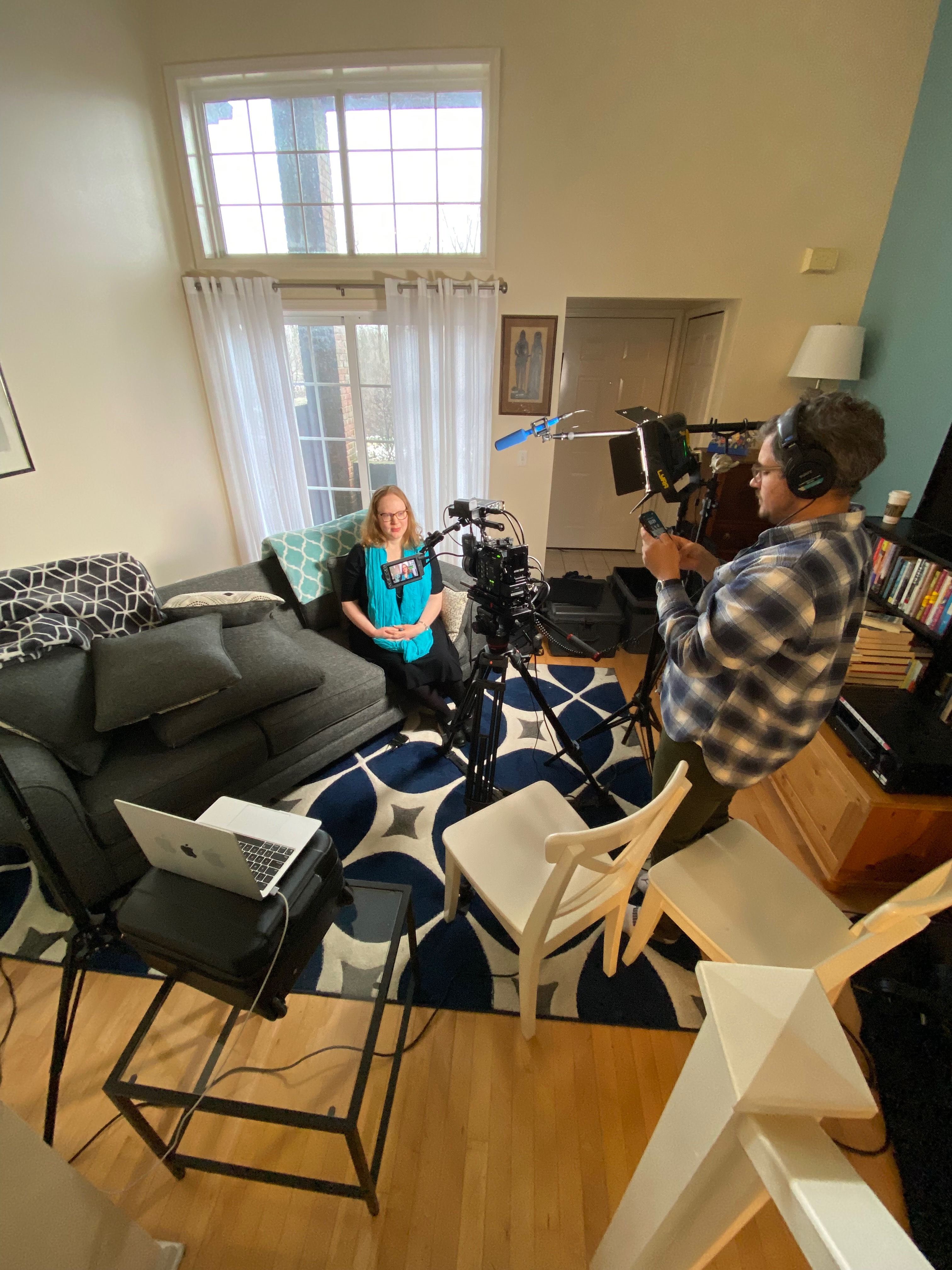
When he and Chris arrived on Saturday morning, I realized how extensive an undertaking even a “simple” video shoot like this one was: they hauled in boxes and bags of equipment, and soon my living room was a maze of lights and cords and gizmos that I couldn’t identify. I sat on the couch while Allister and Chris worked around me, turning this way and that on their directions so they could make adjustments. Should I have an arm resting against the side of the sofa? Should this scarf wind around my throat, or lie open? Did I have a blanket or throw pillow that might add a pop of color? Glasses on or off? Glasses on—which meant that the lights had to be angled at just the right way to avoid glare. Each time even the smallest detail was adjusted, Allister took a photo of the new setup and sent it to Hui Huan in Singapore for assessment.
Finally, everything was in place and we started the main interview. This was, all in all, the easy part—I sat on the couch and answered questions Hui Huan asked over Zoom, repeating and refining the language of my replies multiple times in response to her feedback. The biggest struggle was remembering not to break eye contact with Allister, who sat slightly off to the side; I was supposed to keep my gaze focused on him, not look directly at the camera or at Hui Huan on the laptop screen as she asked me questions.
The real challenge came when we reconvened after a lunch break and Allister explained the various “action” scenes they wanted to film: me showing several pictures and articles to the audience, explaining the stories behind them. Me walking into a room and around my home office. Me working. Me, in other words, moving—at the same time I was talking and handling different props.
😳😳😳
These afternoon scenes were so much more difficult than the sit-down interview in the morning—even though I talked much less, I had to do so while simultaneously running through a mental checklist. Was I maintaining eye contact with Allister, not the camera? Were my clothes shifting or bunching up as I walked? Had the microphone slipped from its position taped underneath my shirt? Did I make sure to place that book on the table face-up, not face-down? What does a natural arm gesture look like? We rehearsed, discussed, shot, and re-shot four or five scenes over and over, Allister and Chris reassuring me that everything I did was basically fine, it just needed small tweaks to be smoother. Still, I was intensely conscious of every slip-up, every time I messed up the continuity of a scene, every bungled attempt to look relaxed while feeling anything but. I’ve undergone basic media training to handle straightforward interviews, but it had never occurred to me that saying yes to documentary work might also involve a fair amount of something like acting.
We finished late in the afternoon, Allister and Chris chatting with me as they packed up their gear and I attempted not to collapse from relief and exhaustion. The days of preparation combined with the adrenaline that had built up over the course of filming left me completely drained; I was thankful I hadn’t attempted to cram in the film shoot amid my workweek. This was a completely new type of experience for me, and more physically and mentally demanding than I had expected—never had I put so much thought into actions like walking up a short flight of stairs!
I think the documentary will be available on CNA and then YouTube later in 2024. When I have a chance to see how my parts turned out, I’ll post the link here.
(Or not, if I look half as awkward as I felt …)
Recommendations
China Stories
Chris Buckley and Amy Chang Chien, “Shih Ming-teh, Defiant Activist for a Democratic Taiwan, Dies at 83”
“Of course I would like to retire. But I have got to think of ways to make money first. In these days, you cannot survive without money,” says Liu Zhongxian, 58, who moved from his home in Hebei province to Beijing in his early 20s. He has now become a construction site manager and is contemplating retirement but has no health care benefits or pension.
Emily Feng, “They flocked to build China’s cities. Now builders are aging with little retirement”
Rebecca Feng and Cao Li, “Desperate Chinese Property Developers Resort to Bizarre Marketing Tactics”
Claire Fu, Brooks Barnes and Daisuke Wakabayashi, “Why China Has Lost Interest in Hollywood Movies”
Tom Grundy, “How the gov’t thwarted HKFP’s effort to ‘tell a good Hong Kong story,’ despite repeated calls from top officials”
Isaac Kardon and Jennifer Kavanagh, “China Is Trying to Have It Both Ways in the Middle East”
Over the next decade, new rail links, bridges, logistics facilities, schools, office buildings and residential towers will transform Hong Kong’s outer fringes and remake the quiet towns and wetlands of the New Territories into an extension of Shenzhen, a Chinese technology hub. The property arm of a Chinese state-owned conglomerate, China Resources Group, has established a joint venture with a Hong Kong company to build residential units in what is being called the Northern Metropolis — signaling Beijing’s support.
Shibani Mahtani, Theodora Yu and Ian Teh, “China is absorbing Hong Kong, as geography follows politics”
Newley Purnell and Neil Western, “A British Businessman Worked in China for Decades. Then, He Vanished.”
Sophie Richardson and Rana Siu Inboden, “Beijing Is Pouring Resources into Its UN Human Rights Review—All to Prevent Any Real Review from Taking Place”
Christian Shepherd and Meaghan Tobin, “Adding to China’s economic troubles, property giant ordered to liquidate”
Katie Stallard, “The future of Xi Jinping Thought”
Vivian Wang, Agnes Chang and Siyi Zhao, “What It Took Young People in China to Get Their Jobs”
Lingling Wei and Charles Hutzler, “He Hunted Corrupt Chinese Officials. Now He’s Set to Be Foreign Minister.”
Wanderings Around the World
Bianca Bosker, “What Being a Museum Guard Taught Me About Looking at Art”
Maggie Blackhawk, “How ‘Killers of the Flower Moon’ Presses Up Against the Limits of Empathy”
Julia Jacobs and Zachary Small, “Leading Museums Remove Native Displays Amid New Federal Rules”
Alexandra Lange, “How to Save Corporate Modernist Architecture”
Thanks to a billionaire investor, media deals and the very best athletes in the sport, the PWHL has already sold out arenas, set attendance records and drawn millions of viewers. It’s a success built upon a simple idea: treat women athletes like professionals, and sports fans will watch them.
Adam Minter, “Women’s Hockey Is Breaking the Ice Ceiling”
Feature Photo: Panda living in a conservation base, Sichuan Province, China, June 23, 2015.
 Maura Elizabeth Cunningham
Leave a reply to Weekly Wanderings: April 14, 2024 – Maura Elizabeth Cunningham Cancel reply