A long downward trajectory in U.S.-China relations, intensified by the Covid-19 pandemic, has resulted in less contact between the two countries. Fewer students are crossing the Pacific to study. Airlines have cut back their flight schedules. Multinational executives look elsewhere for business opportunities. “Engagement,” once the hallmark of the relationship, has withered amid mutual suspicion and anger. Moments of optimism are few and fleeting.
I enjoyed one of those rare moments last November when I walked into the Cleveland Museum of Art’s now-ended special exhibition, “China’s Southern Paradise: Treasures from the Lower Yangzi Delta.” A large sign inside the entrance listed the 42 museums and private collectors that had loaned pieces from their holdings for display in the exhibit. My eyes immediately caught on the numerous institutions in mainland China that had participated—seven in all, representing one-sixth of the lenders that had negotiated with and agreed to send their treasures to Cleveland for the four-month exhibition. (Anyone who has worked with Chinese government institutions can only imagine the amount of communication and paperwork that must have been required to accomplish this feat!) In an article about “China’s Southern Paradise” for the CMA magazine, curator Clarissa von Spee, who spent eight years planning the exhibit, explained that geopolitical concerns were front and center in the minds of everyone working on the project:
This exhibition takes place in a time marked by political tension and a strained relationship between the US and China. The CMA and our six Chinese partner museums see a way to transcend and ease these tensions through cultural exchange, mutual understanding, respect for each other, and collaboration—all through the arts.
The exhibition’s geographic focus invited viewers to consider China’s longstanding connections with the rest of the world, even in times of isolation and upheaval. The Lower Yangzi Delta, or Jiangnan, includes major coastal port cities like Shanghai and Ningbo, as well as centers of commerce, art, and politics along the Yangzi River, such as Suzhou, Hangzhou, Nanjing, and Yangzhou. Across many centuries—“China’s Southern Paradise” spanned the Neolithic period through the Qing Dynasty’s fall in 1911—Jiangnan has been a vibrant nexus of people, objects, and ideas.

It’s also a region of stunning natural beauty (a “paradise,” as the exhibit’s title proclaims), and the pieces on view highlighted the inspiration many artists found in the natural world. Numerous scroll paintings, in particular, explored nature at vastly different scales, depicting scenes ranging from the mountains and rivers that form Jiangnan’s topography to the delicate insects and flowers that pepper the vibrant landscape. I found myself delighted by a Song-dynasty incense burner in the shape of a duck sitting atop a lotus flower; when filled with lighted incense, fragrant smoke would come forth from the duck’s beak. Over eight centuries old, the object exuded a delicate strength, its pale-green porcelain shell barely showing any signs of age.

The first two sections of the exhibit laid the groundwork for an understanding of Jiangnan and the early development of its artistic tradition, mostly focusing on ceramics, scroll paintings, and calligraphy. Introductory placards also took visitors through the changing shape of “China” as dynasties rose and fell, gained and lost control of land. By the time of the Southern Song Dynasty (1127-1279), Jiangnan had become a flourishing region. I lingered on a stoneware vase, its surface covered with lushly undulating waves of painted lines, and read the adjacent placard describing the style of Jizhou ware the piece represented; the text noted that Jizhou ware had also been excavated in Korea and Japan, an indication of the networks that connected Jiangnan with other states in East Asia.
Though this “land of fish and rice” has a long association with nature and agriculture (covered in the exhibition’s third section), by the Ming Dynasty it also featured well-established cities, commerce, and social stratification. The fourth section of “China’s Southern Paradise” turned visitors’ attention to this urban environment and the literati culture it supported. In addition to the scrolls and ceramics of earlier rooms, with this section the exhibition began to more prominently feature other types of artworks—lacquer and mother of pearl pieces, furniture and instruments, artistic rocks and bamboo carvings, items cast in silver and bronze, and more. Section five, “Craftsmanship and Consumption,” emphasized objects notable for both their artistic merit and utility, and also explained how ownership of such pieces was used to demonstrate wealth and good taste. The earliest sections of the exhibit hall were impressive for showing how much had managed to survive the centuries, and for demonstrating the sophistication of early Jiangnan art. Later displays stood out for highlighting the variety in materials, techniques, and topics that marked Jiangnan’s artistic scene in the Ming and Qing Dynasties.
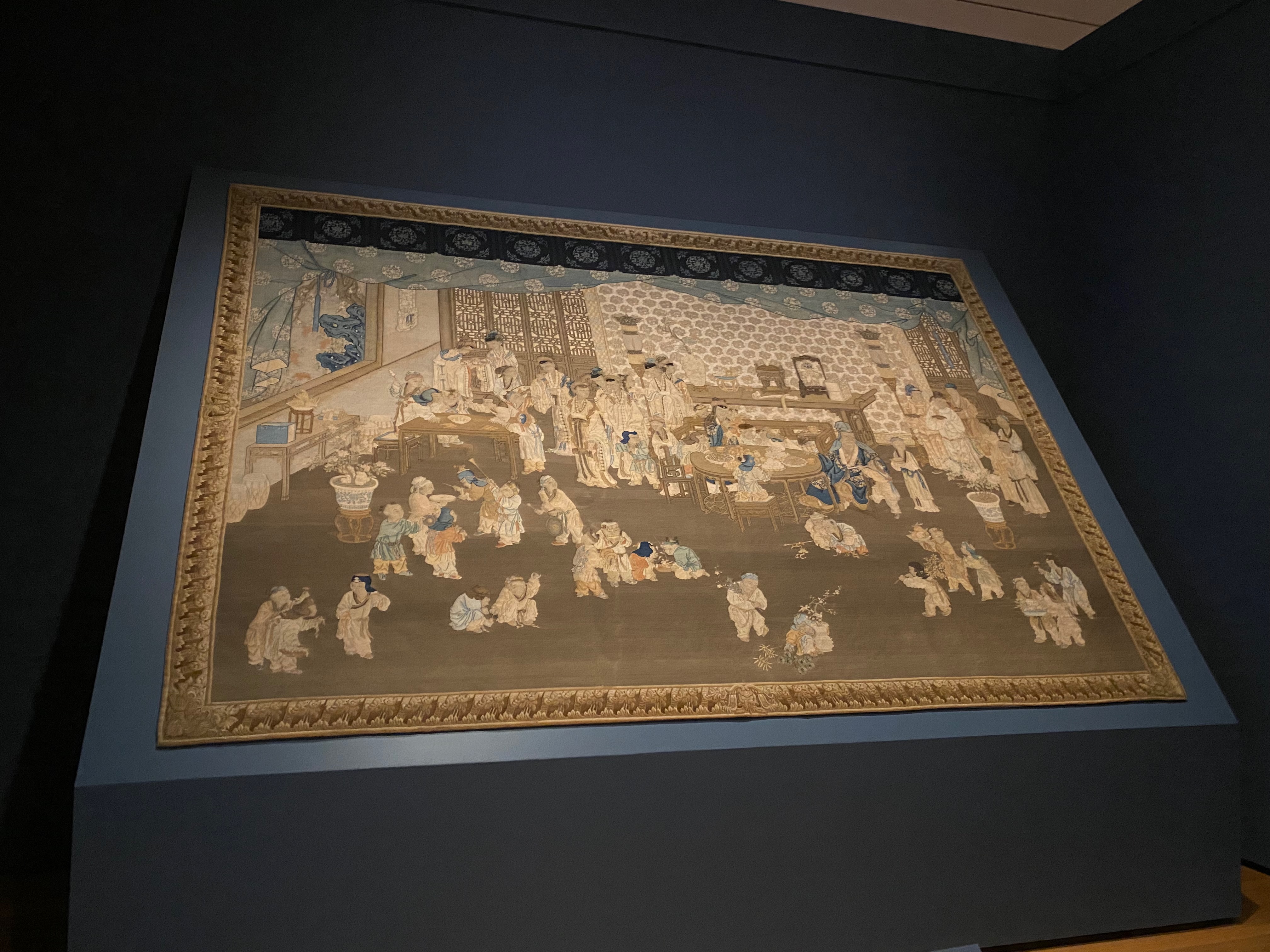
This is also where I began noticing the increasing frequency of references to artistic exchange between China and Europe, as foreign missionaries and merchants started to arrive in China seeking souls and markets. By the 18th century, Jiangnan artists employed more perspective and depth in their paintings, while manufacturers in England and the Netherlands were producing knockoffs of blue and white willow ware for eager local consumers. A massive woven tapestry depicting a large family scene dominated one wall at the exhibit’s end, in one piece encapsulating the blend of Chinese style and European medium that had become more commonplace over the last centuries of imperial China.
The sixth and final section of the exhibition focused on the role that imperial patronage played in fostering the arts of Jiangnan. Emperors commissioned artworks, and others were produced to mark imperial visits to the region. One of the most compelling examples of the latter is a long scroll, which Clarissa von Spee talked about with Veronica Esposito for an article in the Guardian:
Among Von Spee’s favorite pieces in the show is a scroll depicting one of the Qianlong Emperor’s so-called southern inspection tours. Such tours were a way of maintaining the loyalty of outlying regions at a time when communications were far from swift, and power had to be projected majestically. “The emperor’s legitimacy was always at stake,” said Von Spee, “and the center of resistance was in the Yangtze delta region, so they made these processions. They were enormous, very costly, so it shows you that they recognized how important the Yangtze valley was for their empire.”
Although major institutions around the world hold southern inspection tour scrolls, Von Spee purposely chose to exhibit one from the University of Alberta that is much less viewed than others she might have chosen. “I wanted to show a scroll that was rarely seen, and so it’s exciting to have it on display,” she said. A massive, detailed work of over 70ft in length, the scroll offers audiences a rare opportunity to peer into daily life in China hundreds of years ago. “It’s just wonderful to see – over 26 meters long, and we spread it out as far as we can in the exhibition hall. You really get a very authentic, idealized vision of life in the Yangtze delta.”

My favorite piece honoring Qianlong’s travels in Jiangnan, however, was much smaller: a set of colorful ink sticks in various shapes, decorated on both sides. One side shows an image from the Ten Scenes of West Lake (ten classic views at Hangzhou’s central lake), and the other features a poem composed by Qianlong during his journey there in 1780. The boxed set of ink sticks looked exactly like most of the grab-and-go souvenirs that I’ve seen filling the shelves of 21st-century stores in Chinese tourist locations—something that appears useful but is too special to be used and therefore becomes a lingering knickknack long after the trip has faded in memory. I smiled at the thought of such objects filling imperial storehouses upon Qianlong’s return to Beijing.
It took me nearly two hours to walk through all six sections of “China’s Southern Paradise,” and I ended my tour of the exhibition somewhat overwhelmed by everything I had just seen. The efforts by von Spee and her colleagues at the CMA to organize a large-scale assembly of Jiangnan art and artifacts resulted in an exhibit that demonstrated the incredible longevity and variety of artistic work in the region. Many of my favorite pieces were those on loan from institutions in China, and the collection would have suffered had they not made the trip to Cleveland. Working with Chinese museums, despite the tensions in U.S-China relations, resulted in an exhibit of impressive depth, dimension, and diversity. “China’s Southern Paradise” was a compelling argument not only for the importance of Jiangnan art, but also for the benefits of pursuing engagement even in times when it has fallen out of favor.

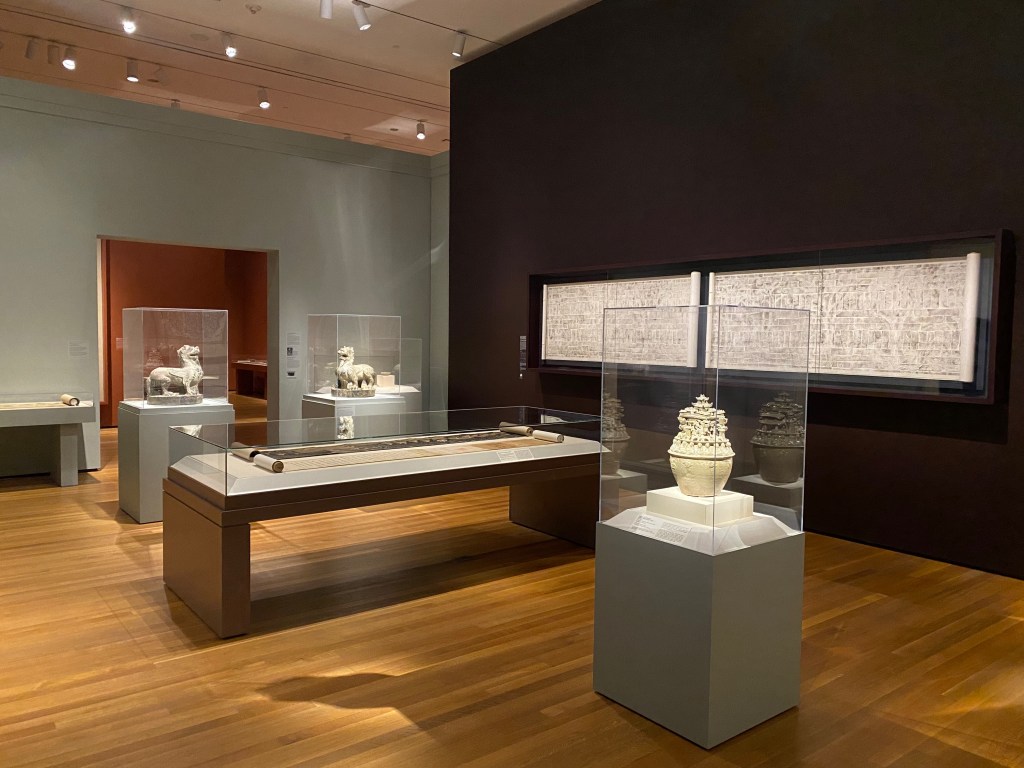
Feature Photo: A room in the “China’s Southern Paradise” exhibition, Cleveland Museum of Art, November 15, 2023.
 Maura Elizabeth Cunningham
Leave a reply to Weekly Wanderings: January 21, 2024 – Maura Elizabeth Cunningham Cancel reply