WHAT A WEEK
We’ve truly made the final transition from news cycle to news tornado. As the number of links below indicate, I spent way too much time every evening sitting on my couch doom-scrolling on Bluesky. I need to do less of that, but it’s hard not to feel an obligation to read and to witness. I want to be an informed citizen. Unfortunately, right now that means consuming too many stories of unfathomable cruelty and ignorance. I tried to make some space for less apocalyptic fare as well; you’ll find those links down in Wanderings Around the World.
Thanks for joining me this week. Stay safe and stay warm. ☃️
Recommendations
China Stories
Cate Cadell and Christian Shepherd, “China fires top general in shocking purge of senior military command”
Yangyang Cheng, “Silicon Island: How Taiwan became the chipmaker for the world”
Last week, the Hong Kong Film Awards (香港電影金像獎), the city’s premier annual cinema event, excluded four films from its official 2025 contenders list without explanation, prompting concerns about censorship in what was once one of Asia’s most vibrant film scenes. — Mark Chiu, “Silent Films”
Mark Chiu, “Canada’s Last Chinese Daily Closes”
Helen Gao, “The Great Chinese Vibe Shift”
Jeremy Goldkorn, “For Chinese Writers, a Room of Their Own on Fifth Avenue”
Andrew Higgins, with visuals by Gilles Sabrié, “The Chinese Island Where Dreams of Real Estate Glory Never Die”
Hu Ping, “Six Years since the Wuhan Lockdown: Seeking Accountability for a Historic Catastrophe”
Dalia Parete, “Shanghai’s Last Newsstand”
Andrew Stokols, “Feng Shui: between spirituality and state legitimation”
Joseph Torigian, “Obedience, Ambiguity, and Punishment: The Chinese Military at Tiananmen Revisited”
Minnesota
On March 16, 1965, a thirty-nine-year-old woman named Viola Liuzzo got into a late-model Oldsmobile and drove eight hundred miles from her home in Detroit, Michigan, to Selma, Alabama. Days earlier, following the Bloody Sunday protests, where voting-rights demonstrators had been tear-gassed and beaten, Dr. Martin Luther King, Jr., had issued an appeal to people of conscience across the country to come to Alabama and participate in what had already become one of the most consequential theatres in the movement for equality. Liuzzo, a white woman who’d been born in Pennsylvania, moved to Michigan, where she eventually married an official with the Teamsters and became active in the Detroit N.A.A.C.P. She told her family and friends that she felt compelled to do something about the situation in Alabama, arranged child care for her five children, and drove south. — Jelani Cobb, “From Selma to Minneapolis”
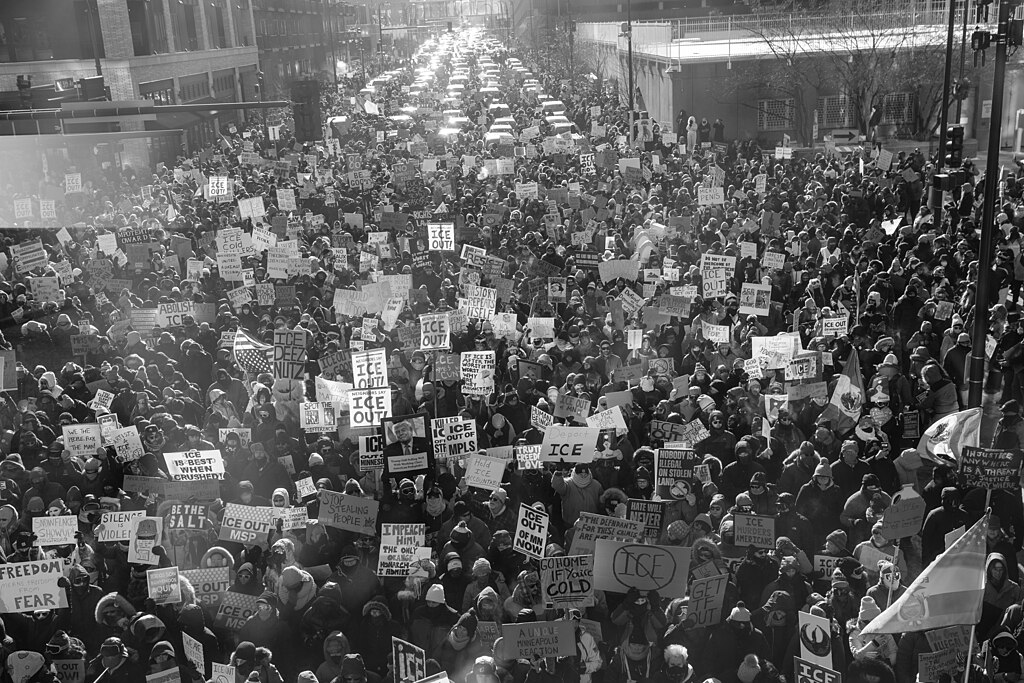
Minnesota is under siege. It might not yet be a civil war, but what the White House has dubbed “Operation Metro Surge” is definitely not just — or even primarily — an immigration enforcement operation. It is an occupation designed to punish and terrorize anyone who dares defy this incursion and, by extension, Donald Trump’s power to wield limitless force against any enemy he wishes. — Lydia Polgreen, “In Minneapolis, I Glimpsed a Civil War”
David Smith, “‘This is what fascism looks like’: terror in Minneapolis reminiscent of civil war”
Michael Tisserand, “In Minneapolis, there are echoes of Katrina”
Benjamin Wallace-Wells, “Why Trump Supports Protesters in Tehran But Not in Minneapolis”
Trump’s Second First Year
Daniel W. Drezner and Elizabeth N. Saunders, “Trump’s Year of Anarchy: The Unconstrained Presidency and the End of American Primacy”
There is something self-aggrandising about most American cultural depictions of authoritarianism. The stories narrate life behind enemy lines – whether in the 1930s or in outer space – in a way that implicitly tells the viewer that the US is different. It really couldn’t happen here. This has left many Americans unprepared for everyday conditions of repression – how life changes only incrementally, how the things you’ve always enjoyed mostly remain the same. Some of my happiest childhood memories are times spent with family in Kenya under dictatorship in the 1980s. — Aziz Rana, “Days of Complicity”
The President’s House
Maxine Joselow and Jennifer Schuessler, “How the National Park Service Is Deleting American History”
John Garrison Marks, “We’ve Never Agreed About George Washington and Slavery”
Jake Spring, “Park Service removes slavery exhibit at Independence Park in Philadelphia”
Wanderings Around the World
Ghaith Abdul-Ahad, “Out of the ruins: will Aleppo ever be rebuilt?”
Emrah Atasoy and Jeffrey Wasserstrom, “How George Orwell’s Nineteen Eighty-Four predicted the global power shifts happening now”
I can’t speak for everyone, but my mind tends to treat writing an article, making a video, writing a song, cooking a meal, drawing an image, and, apparently, designing software the same way. It’s not a matter of just “generating” something perfect from my head, but exploring the tension that exists between what I’m imagining and the limitations of my stupid meat body. That’s actually the exciting part. It also lets me figure out if something has turned out wrong or just resulted in a happy accident. Vibe coding, like every new trend coming out of Silicon Valley, turns this process — the entire act of creativity, itself — into a slot machine. One more pull on the AI and maybe it will figure it out for you. You won’t understand how any of it works, of course, or feel particularly proud of what you’ve done, but maybe you’ll have something. Just a few more dollars for some more tokens. C’mon, just pay a bit more. — Ryan Broderick, “Am I too stupid to vibe code?”
Paul Hockenos, “What One Film’s Success Reveals About Today’s Russia”
Dillon Osleger, with interactive maps by Jeremy Clark, “The Ground Truth”
Anne Helen Petersen, interviewing Bethann Garramon Merkle, “Behold, a Deeply Compelling Science Writing Manifesto!”
Will Ripley, “Sex, death and betrayal: This North Korean movie shows things audiences have never seen before”
Ilaria Maria Sala, “How Singapore Made Orchids a Tool of Foreign Policy”
Elizabeth Tsurkov, “I Was Kidnapped by Idiots”
Daniel Traylor, “Shinkansen vs. Amtrak and the lost art of small talk”
Colin Warren, “Meet the Alaska Student Arrested for Eating an AI Art Exhibit”
Featured photo: Protest in Downtown Minneapolis, January 23, 2026. Photo by Lorie Shaull and used under a Creative Commons license.
 Maura Elizabeth Cunningham
Leave a comment