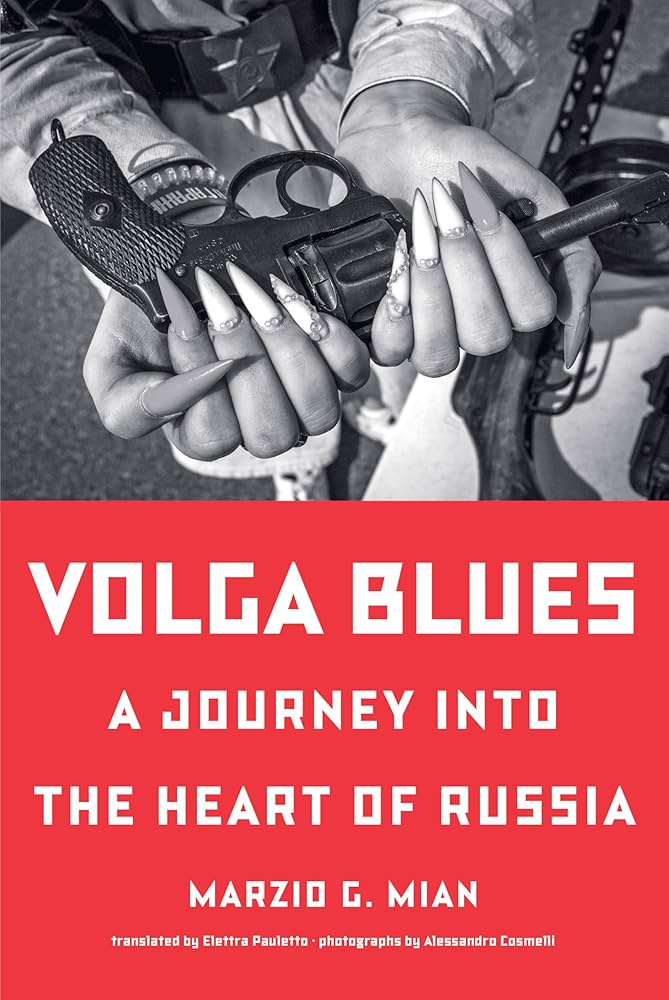
A current of tension runs throughout the chapters of Volga Blues: A Journey into the Heart of Russia. Sometimes it’s weak, and I forget that Italian journalist Marzio G. Mian and photographer Alessandro Cosmelli are traveling around Russia without authorization or the proper visas, posing instead as a historian and his friend. But then something shifts and the current picks up, reminding me of all the threats that could pull Mian and Cosmelli under: the pair’s volatile and frequently intoxicated drivers/fixers, Vlad and Katya; interview subjects who grow suspicious of a “historian” too interested in the present day; state security agents who might notice their presence and descend at any time; potholes. I feel Mian’s constant alertness as he monitors each situation and evaluates whether he and Cosmelli can ride it out or need to bail.
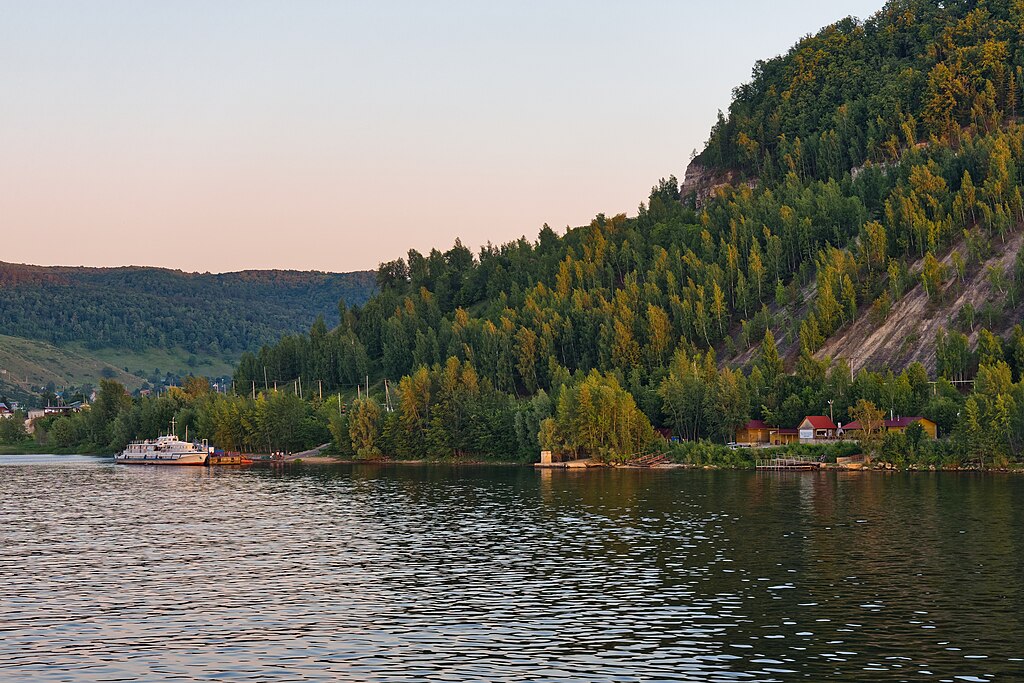
The two were in Russia during the summer of 2023, following the Volga River from its source southeast of St. Petersburg to the delta in Astrakhan where it meets the Caspian Sea. Along this meandering 2,000-mile course, Mian hoped to get insight into a Russia largely inaccessible to foreign reporters. Vladimir Putin had launched a war against Ukraine 18 months before, bringing sanctions upon his country and cutting it off from the rest of Europe. “Russia, as seen from the West,” Mian writes in the book’s preface, “has become distant, mysterious, and hostile—a world unto itself.”
This, of course, seems a throwback to the Cold War days of the Soviet Union, which turns out to be an appropriate reference. Mian meets many people who have taken up Putin’s promotion of Joseph Stalin as a national hero, a man strong enough to stand up and lead his country through adversity. On a river cruise, a teenager wears a shirt sporting a graphic of Stalin’s face—the hot youth clothing item that summer. A statue of Stalin greets Mian and Cosmelli when they enter a massive meat and dairy production facility in Tatarstan, where the founder of this “Communist-Stalinist enterprise” drives an illegally imported Mercedes and enthuses about the boost to his business provided by sanctions that prevent imports from abroad. This Stalin appreciation isn’t new (M. Gessen refers to it in their 2017 book, The Future Is History), but the prevalence noted by Mian indicates that it has ramped up in intensity.
There’s also the association of Stalin with both great suffering and great victory in war, encapsulated in larger-than-life stories about the failed Nazi siege of Stalingrad—now Volgograd, though in 2025 Putin renamed the local airport “Stalingrad International.” At the city’s memorial to the battle, Mian’s guide notes that visitors have increased tenfold since 2021 due to citizens making pilgrimages to pledge their allegiance to the country: “People come here to swear an oath, and to prove to themselves they are Russian even when times are hard.”
Times, for most of the people Mian encounters along the Volga, are indeed hard. The most direct cause of pain and struggle is the war in Ukraine, in which at least 160,000 Russian soldiers—and likely many, many more—have been killed. Among these is Pavel, an ethnic Romani who had taken on debt to get a taxi license near the Volga town of Rybinsk. When the Russian government offered almost $3,000 per month to enlist (compared to the $600 or less he generally earned), Pavel signed up. Forty days later he was dead. Mian meets his widow, Valentina, who acknowledges that while Pavel supported the war, “he left only to make a few bucks … his ideals didn’t have anything to do with it. In the end, my Pavel was a mercenary, right?” In the corner of Valentina’s house is a small shrine to Pavel—sharing space with “his beloved Stalin,” Valentina notes.
Mian focuses each chapter of Volga Blues on his meetings with an individual or a group whose story represents a strand of experience in Russia today. These specific stories are at the center of a sprawling web, linking nodes of history, literature, religion, commerce, nationalism, and more. Few of his interviewees seem truly optimistic: even the people who speak of their expectations that Russia will win the war in Ukraine feel grimly braced for continued conflict and a Pyrrhic victory at some vague point in the future.
Even though I knew from the book’s existence that Mian and Cosmelli made it out of Russia, I stayed in suspense through to the very end of Volga Blues as I read about their preparations for departure. Would they successfully remain under the state’s radar? The tension lasts until the final sentence.
Navigating Putin’s Russia as an undercover foreign journalist requires alertness, nerves of steel, and the ability to understand shifts in the current that threaten to wreck the journey. Thanks to the combined abilities of Mian and Cosmelli, as well as translator Elettra Pauletto, English-language readers now have this valuable work of reportage to inform our understanding of Russia in the 2020s. It’s a place, Mian conveys, where the average person has plenty of reasons to be singing the blues.
As a bookshop.org affiliate, I earn a small commission if you use the above link to purchase this book.
Review copy provided by W.W. Norton.
Featured image: Volga River near Samara, June 19, 2021. Photo by Wikimedia Commons user Alexxx1979 and used under a Creative Commons license.
 Maura Elizabeth Cunningham
Leave a comment