
Greetings from the first snow of the season in Ann Arbor.
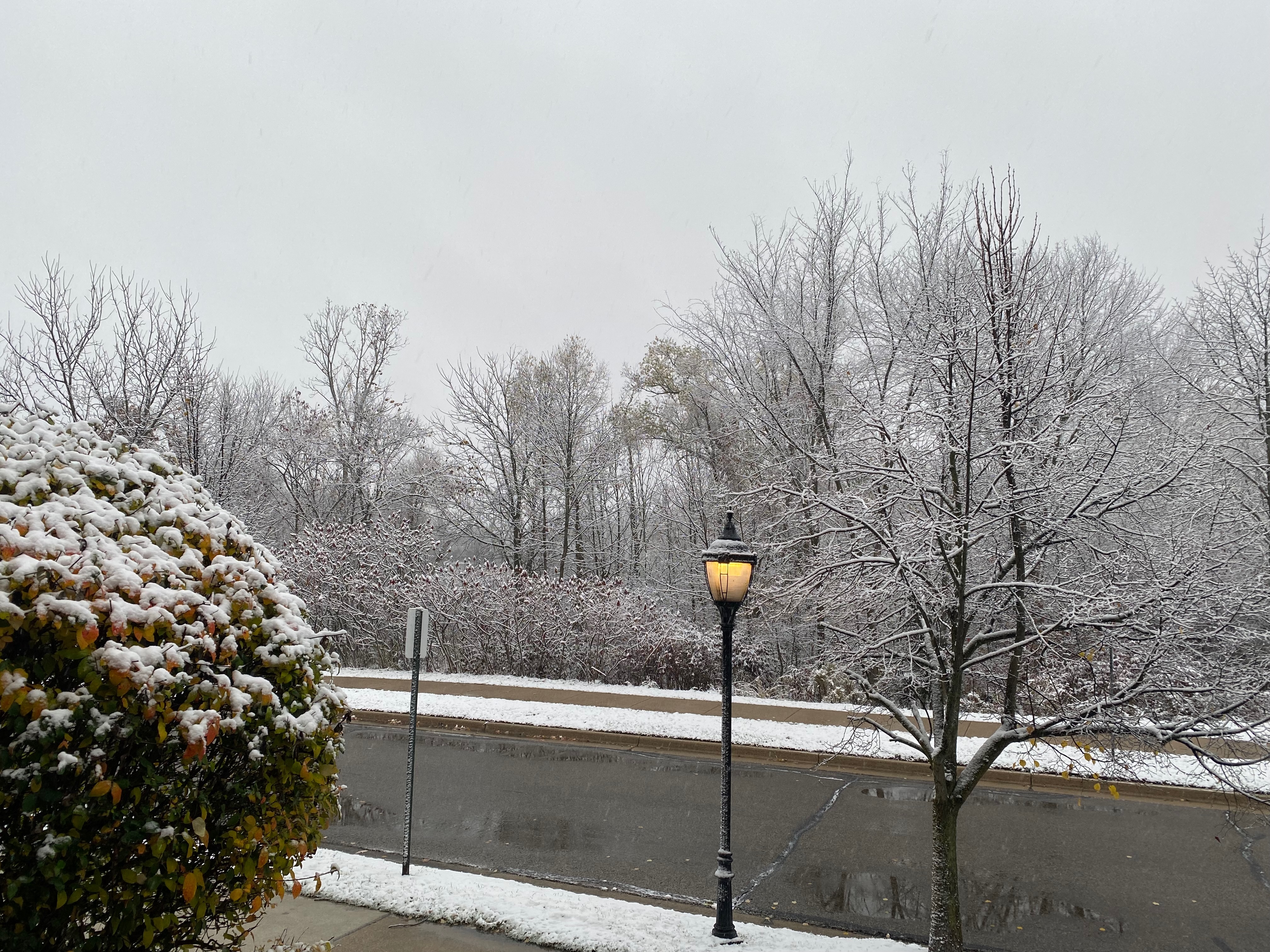
Although I saw one forecast yesterday that predicted 4-6 inches of snow for us today, it has now settled down to 1-3 inches—enough to make for a picturesque Sunday at home, not enough to make life overly difficult for anyone on the roads.
My snow day plans involve some time on the couch (reading, though I’m not sure which book yet) and some time in the kitchen. A couple of weeks ago I wrote about my friend Anna Ansari’s new cookbook, Silk Roads, and last Monday I used it to cook two outstanding recipes: Korean-style carrot salad and An Uzbek Plov.

The plov, in particular, turned out really well. The instructions looked complicated and intimidating at first, but I took my time, followed each step exactly as Anna had written them, and then saw everything come together like magic. It’s the same feeling I have turning a heel when knitting a sock—it doesn’t seem like it will work, and then suddenly it does.
I already have ideas for changing up the plov next time (adding mushrooms, using dried cranberries instead of apricots), but first I want to try something else. Today I’m making two Uyghur-inspired recipes, for a chickpea and carrot salad (yes, I do love carrot salads) and cumin tofu. Fingers crossed that those both go well.
Thanks for joining me this week.
New Goodreads Reviews
“Books that take place on boats” is this week’s theme.



Also: Sarina Bowen, Thrown for a Loop (3 stars) • Stephanie Perkins, Overdue (4 stars)
Recommendations
China Stories
Eliot Chen, “Laura Murphy on How China Forced Her University to Halt Her Xinjiang Research”
Jeremy Goldkorn, “A New Global Scene for Independent Chinese Film” (UPDATE: Human Rights Watch, “China: Authorities Shut Down Film Festival in New York”)
Damian Grammaticas, “China intimidated UK university to ditch human rights research, documents show”
Diaa Hadid and Omkar Khandekar, “The Dalai Lama created a Tibetan capital in exile in India. It’s shrinking”
Amy Hawkins, “UK university halted human rights research after pressure from China”
Tina Kanagaratnam, “Shanghai Sedan Nostalgia”
Andrew Peaple, “Jennifer Lind on How China Mixes Autocracy and Innovation”
Alexandra Stevenson and Joy Dong, “In China, Victims of Abuse Are Told to ‘Keep It in the Family’”
Li Yuan, “In Chinese American Families, There’s a Generational Split on Mamdani”
Viola Zhou, “‘I Deliver Parcels in Beijing’: Chinese literary sensation reaches U.S.”
Wanderings Around the World
William Gourlay, “The Forgotten Photographs of Iraq’s Yazidis”
Lourdes Martin, “The World May Have Forgotten About Afghanistan, But the Afghan Diaspora Hasn’t”
Amardeep Singh, “What Mamdani Learned from His Mother’s Films”
Wichuta Teeratanabodee, Jeffrey Wasserstrom, and Sasha Razor, “Not Just Six Months but Six Years: Gen Z Activism from Asia to Belarus and Beyond, 2019-2025”
Standout Stories
Here, I’ve paired two complementary stories about AI in China—the first with a wide-angle perspective, the second zooming in to consider the work of one AI entrepreneur.
Like in the U.S., the AI race/bubble is sucking investment and energy (both in kilowatts and zheng nengliang) out of other sectors and concentrating wealth and capital in a few leading firms. This is a commonality that is often lost in discussions of U.S. and China tech competition—AI promises wider benefits but seems to be concentrating wealth and resources even further, accelerating inequality and resentment in society that were already bubbling, both during China’s “Gilded age” boom years, and in the populist backlash toward the elites that has transformed American politics.
— Andrew Stokols, “Ambition and Anxiety: Visiting China During the Age of AI”
Three months ago, engineers at Anthropic discovered something strange: an account burning through Claude’s computational resources at an impossible rate, 24/7. The announcement came with a striking revelation: one user, on a $200 monthly plan, had consumed $50,000 worth of model usage—a global record.
The culprit is a Beijing-based programmer named Liu Xiaopai. As an entrepreneur who’s been building products for over two decades, first working for a big company and now on his own, he used Claude Code ceaselessly to make money: building a dozen AI products while he slept, selling them to users in places (mostly the West) he’d never visit. Some at Anthropic called him exploitative, and people on Reddit discussed this crazy phenomenon with mixed reactions. Liu Xiaopai didn’t find the whole thing embarrassing; instead, he bragged about it.
— Afra Wang, “Story of A Beijing Vibe Coder”
Featured photo: Students at a Tibetan school in Dharamsala, India, September 16, 2010.
 Maura Elizabeth Cunningham
Leave a comment