Thanks for joining me this week.
New Goodreads Reviews


Recommendations
China Stories
Eliot Chen, “Laura Murphy on Enforcing America’s Ban on Uyghur Forced Labor”
Wang, who has more than 800,000 subscribers on YouTube, is representative of a small but influential part of the Mandarin-language media landscape. He is part of an exodus of media professionals who have left Hong Kong and mainland China in the past decade; and one of a handful who have started posting news and analysis videos on YouTube. Wang serves an audience of Chinese expatriates – along with mainlanders savvy enough to get round China’s great firewall – who tune in hoping that he can fill in the gaps left by propaganda, censorship and disinformation.
— Lauren Hilgers, “‘Americans are democracy’s equivalent of second-generation wealth’: a Chinese journalist on the US under Trump”
John Leicester and Kanis Leung, “Read what a Chinese officer wrote of D-Day in his diary salvaged in Hong Kong”
In the days before and since Oct. 1, when the visa was supposed to come into effect, commenters have accused the government of inviting foreigners to steal jobs from Chinese people, at a time when young people are finding it harder than ever to land work. They have suggested that foreigners are being blindly worshiped, a longstanding national sore point.
— Vivian Wang, “China Wants Foreign Scientists. The Public Says No, Thanks.”
Wanderings Around the World
France 24, “France’s postal service rolls out croissant-scented stamp”
Austin Meek, “Living next to a college football stadium? Complicated at Cal, profitable at Michigan”
Chris Osieck, “Caught Between States as an Empire Dissolved”
Jennifer Schuessler, with visuals by Erinn Springer, “In the Wake of the Edmund Fitzgerald”
Clint Smith, “What Is Colonial Williamsburg For?”
Standout Story
What happened to Tonga could, in theory, happen to anyone – even to the world’s biggest, wealthiest nations. The two US coasts, for instance, may be far more thickly connected with cables than Tongatapu, but all those cables do eventually run into the inky depths of the deep ocean, where they’re protected by neither military nor legal muscle. The world today has come to depend utterly on these cables – and in tandem, these cables have grown more and more exposed to the whims of rogue corporate and national actors. The future of the internet, in part, will entail the weaponisation of its submarine cable systems. Information, after all, is wealth and power – not only in how you use it, but how you can throttle it.
— Samanth Subramanian, “Extremely offline: what happened when a Pacific island was cut off from the internet”
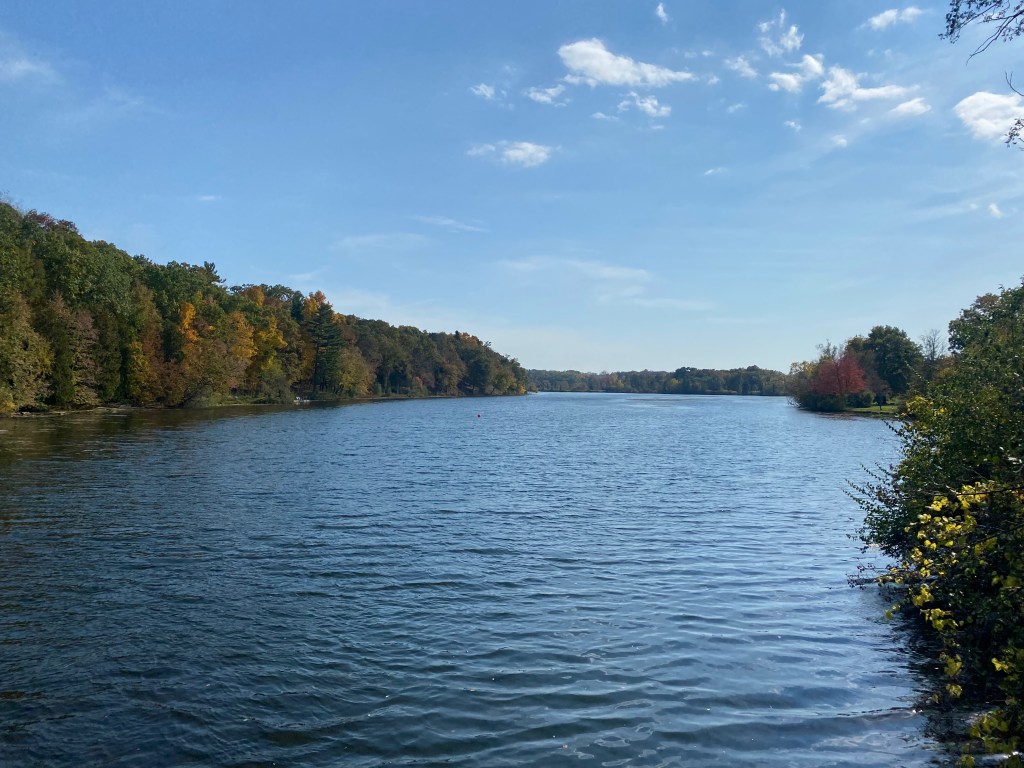
Featured photo: By the Huron River in Ann Arbor, Michigan, October 18, 2025
 Maura Elizabeth Cunningham
Leave a comment