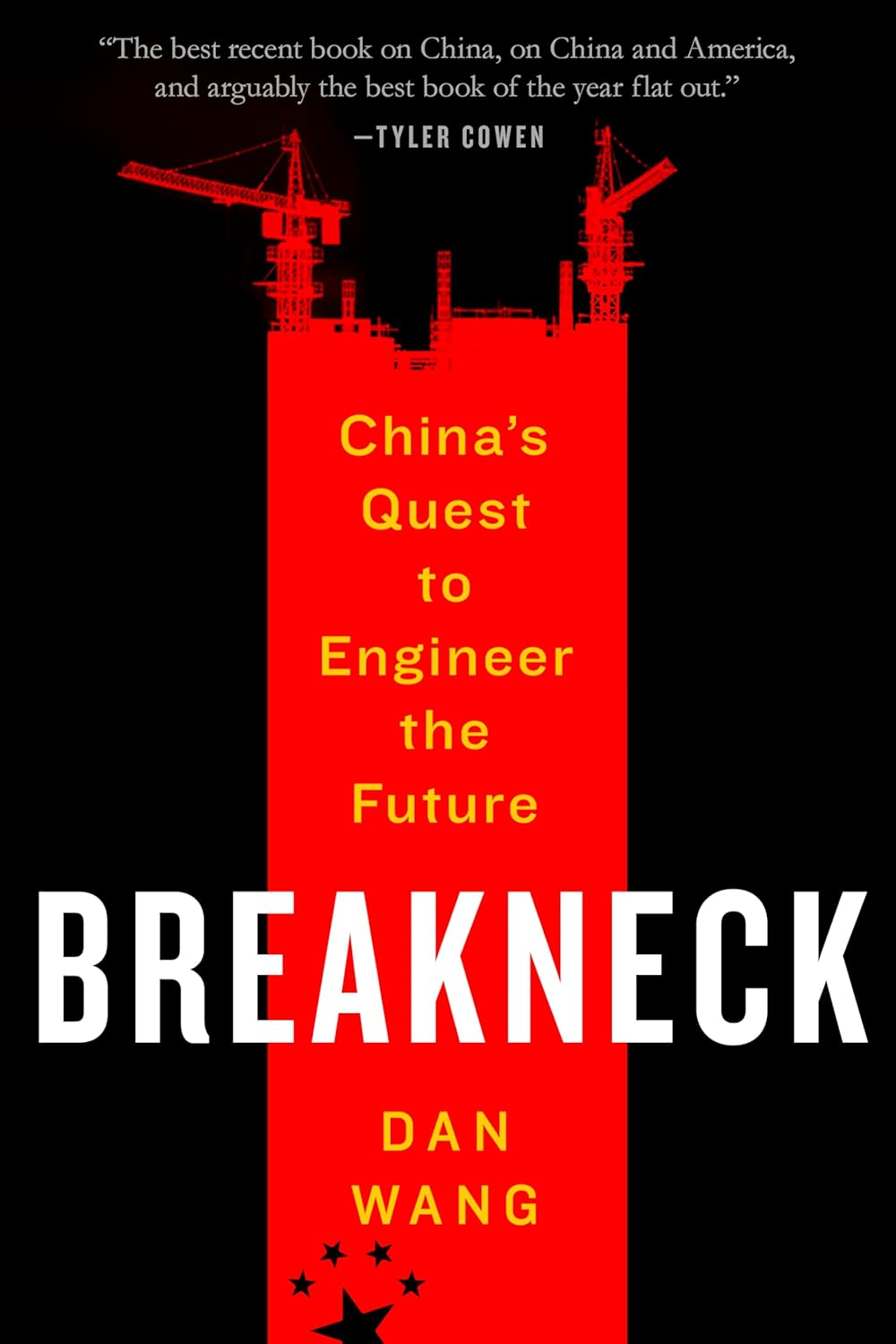
The first copy of Breakneck I received looked like the quintessential fear-mongering China book. Against an inky black background a red graphic appeared—somewhat difficult to identify, but it seemed to be a towering building with cranes or construction equipment extending from its top. BREAKNECK, in white, stretched across the lower third of the space, and the five stars that appear on the flag of the People’s Republic of China showed up near the tower’s base. In its body, written in a shade of yellow also taken from the PRC flag, was the book’s subtitle: “China’s Quest to Engineer the Future,” with the name of author Dan Wang below. In its colors and imagery, this was practically the cover that generative AI would compose for a book about how China was going to rule the world.
But that was just a galley—one of the flimsy early copies that publishers produce and send out to potential reviewers. When a finished hardcover of Breakneck arrived in my mailbox a couple of months later, its new cover conveyed a completely different tone. Instead of the dominant red, yellow, and black, the color palette was hazy gray, green, and brown. The graphic had been replaced by a photo, which showed a solitary woman standing in a dry field, staring up at a cluster of towering buildings under construction in the distance. In a softer shade of yellow and a serif font, “China’s Quest to Engineer the Future” now felt explanatory, not ominous.

The final cover for Breakneck much more accurately conveys what Wang, a fellow at Stanford University’s Hoover History Lab, delivers in this energetic volume: a thoughtful exploration of the Chinese Communist Party’s approach to governing and how it compares with what’s happening in the United States these days. “The starkest contrast between the two countries,” Wang argues, “is the competition that will define the twenty-first century: an American elite, made up of mostly lawyers, excelling at obstruction, versus a Chinese technocratic class, made up of mostly engineers, that excels at construction.”
Wang’s engineers-versus-lawyers formulation is the aspect of Breakneck sure to get attention, and likely to spark debate. It’s a compelling setup, but the United States/lawyers side of the equation feels less developed, and more subject to current events, than the China/engineers side. (Indeed, in the months since Wang finished writing Breakneck and Donald Trump has run roughshod through the American government, we could do with more lawyers and obstruction.) Quibbles with the book’s framing, however, should not overpower the fact that in Breakneck Wang offers his audience an outstanding analysis of China in the 2020s—both its strengths and its shortcomings.
This is not surprising, as Wang honed his observations while the technology analyst at Gavekal Dragonomics, which gave him experience considering China at the macro level and synthesizing his understanding of (geo)politics, society, and industry. While he spent stints based in Beijing, Shanghai, and Hong Kong, Wang also traveled widely and acquired a balanced understanding of China’s urban centers and rural regions. Between 2017 and 2023, he published elegant, thought-provoking annual letters that became essential reading for all of us interested in the country.
Breakneck reads like a book-length compilation of seven letters, each chapter focusing on one aspect of Chinese economy, society, and politics. Wang begins by describing the “engineering state” of the Chinese Communist Party, which combines “construction, capitalism, and control” to maintain Party rule, its “fundamental tenet … to look at people as aggregates, not individuals.” In the first few chapters, he explicates the incredible scale of the mega-projects so beloved by Chinese government technocrats, contrasting them with the poor showing of the contemporary United States in such efforts. Someone unfamiliar with China would likely read the chapters on infrastructure and manufacturing and assume that Wang is here to champion the Chinese system.
But starting with chapter 4, the fallacy of approaching governance like an engineering problem to solve becomes more apparent. First with the One-Child Policy, then with its Zero-Covid lockdowns, the Chinese Party-state has pursued quantitative goals with inflexible, single-minded dedication, regardless of the havoc and pain inflicted on people in the process. This is where viewing the population as a mass of numbers to manage requires willful blindness on the part of Chinese officials, who succeed by rejecting any awareness of the individual circumstances in the lives of people under their purview. Whole-heartedly committed to meeting arbitrary numerical targets, Wang states, “engineers will simply follow the science until it leads to total immiseration.”
Living under such excesses, Wang observes, “entire generations feel whipsawed by the engineering state’s violent mood swings.” The standard of living has improved by leaps and bounds in previous decades—but at what cost? Younger Chinese today grapple with this question, and some have chosen the option to rùn, a Chinese-English play on words that describes their decision to leave the country and start new lives elsewhere, free of the Party-state’s ever-increasing political control and with work-life opportunities not possible in China. But the decision to rùn is not an easy one, and there’s no guarantee that the future will be better elsewhere.
This uncertainty comes home in Breakneck’s final chapter, in which Wang reflects on his parents’ decision to leave China in 2000, when he was seven years old. Settling first in Canada, then in suburban Pennsylvania, his family struggled ways that might not have been the case had they stayed in Yunnan just as the Chinese economy was beginning to take off. But their decision to leave led to their son having the opportunity to see both the United States and China from inside and out, and to combine the critical perspective of an analyst with the deep thinking of the college philosophy major Wang was. This results in a nuanced examination of China’s strengths and weaknesses, with ample consideration of what the United States and China can learn from each other. Breakneck is not an alarmist book—despite that original cover design—and offers readers a much-needed alternative to the zero-sum perspective on U.S.-China relations so prevalent today.
 Maura Elizabeth Cunningham
Leave a comment