Today’s post is the second of two on books I’ve read about New Orleans over the past few months. To read part one, on the city’s history, please click here.


Thin, sketchy lines and muted colors fill the pages of Drowned City, a graphic history of Hurricane Katrina by writer and artist Don Brown. Written for a teenage audience that would have little to no memory of the storm when the book was published in 2015, Drowned City follows the hurricane from its origin as swirls of wind in Africa, weeks prior to arrival in New Orleans, to the morning of Monday, August 29, 2005, when winds and rain battered the city. The hurricane itself did not cause the greatest damage—that came after, when levees failed and caused flooding throughout New Orleans.
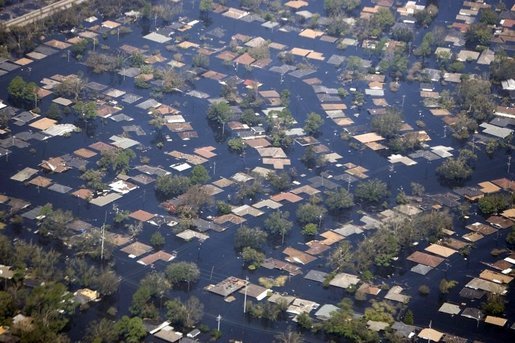
Brown depicts what followed Katrina’s landfall in clear and harrowing detail. His watercolors show people seeking refuge on the roofs of their houses, pushing into the Superdome and Convention Center for shelter, wading through streets filled with toxic brews of waste and water. Police officers abandon their posts and “gun-toting business owners” patrol their shops to fend off looters. Using statements from New Orleanians reported at the time, Brown conveys their confusion and desperation in the face of a disaster unlike any in memory.
Drowned City also tells stories of bravery and compassion—the volunteers who used their own boats to rescue people stranded throughout the city and the government agencies organized enough to act quickly and decisively when needed. Such stories, though, are infrequent episodes in the pages of this book.
Brown does not attempt to turn Hurricane Katrina into a false narrative of victory in the face of obstacles or of humans triumphing over nature. Katrina revealed just how unprepared most public officials were for a storm of this scale, and Drowned City explores the gap between those who anticipated a massive Gulf hurricane and those who needed to ready the city for the day it arrived. The disconnect between those two groups contributed to a catastrophe that continues to haunt New Orleans and its residents two decades later.
The staff of Memorial Medical Center had worked through hurricanes before, caring for sick and injured New Orleanians while wind and rain whipped around the 80-year-old building. Memorial had always seemed like a fortress, sheltering those inside from raging storms; in fact, hospital staff often brought their own families and pets to work with them when a hurricane was forecast. Many thought there was no safer place to be.
Hurricane Katrina, though, challenged Memorial—both the building and the people working within it—in unprecedented ways. Physician and writer Sheri Fink describes this ordeal in Five Days at Memorial: Life and Death in a Storm-Ravaged Hospital, a detailed and distressing account of a week that would haunt many for years to come.
Memorial made it through August 29, when Katrina itself hit New Orleans, in good shape. Although the city power supply failed and the hospital had to switch to its backup generators, doctors and nurses cared for their patients with relatively little disruption. Damage to the facility was limited to some blown-out windows, holes in the roof, and flooding in the basement and first floor. “The hospital seemed to have weathered one more storm,” Fink writes, with those inside the building breathing a sigh of relief, unaware of the nightmare awaiting them the next day.
August 30 was when the situation began to go south—rapidly. The failure of New Orleans’s levee system sent 15 feet of water toward Memorial and exposed the fact that the administration’s emergency preparedness committee had plans in place to handle one system failure, but not multiple simultaneous failures:
[The] emergency committee had ranked hurricanes, floods, and power outages among the highest-priority emergencies, but the hospital’s preparedness plan for hurricanes did not anticipate flooding. The flooding plan did not anticipate the need to evacuate. The evacuation plan did not anticipate a potential loss of power or communications. Most critically, the hurricane plan relied on the assumption that the hospital’s generators would keep working for a minimum of seventy-two hours, although they were never tested to run that long. The entire 273-page set of twenty separate plans offered no guidance for dealing with a complete power failure or for how to evacuate the hospital if the streets were flooded. There was no mention of using helicopters to evacuate the hospital. There was no contract or arrangement for a company to supply them.
As the waters rose, Memorial staff rushed to evacuate anyone who could be moved easily and contemplated how to handle patients with more complex needs. This, in retrospect, clearly appears to be the turning point: by prioritizing those who needed the least assistance, rather than the most, Memorial was soon left with several dozen medically fragile patients, no air conditioning, increasingly exhausted staff, and rapidly dwindling resources. Ultimate oversight of the situation also did not lie with those on site in New Orleans, but at the headquarters of Memorial’s owner, Tenet Healthcare, in Texas. Inconsistent and unclear communication between Memorial and Tenet only added to the confusion.
The backup generators failed. Staff members shifted into survival mode, doing their best to care for patients on ventilators and in need of constant monitoring, but it soon became apparent that they wouldn’t save everyone. Patients began to die.
Some of those who died were already terminally ill and in hospice, their passing accelerated by the heat and improvised nature of their medical care. But others—at least 20, if not more—died due to lethal doses of morphine and other drugs, administered by two Memorial doctors and several nurses who had become convinced that there was no other way out. The patients were too sick to evacuate. The medical staff could not evacuate as long as patients remained alive in the building, which was itself on life support. Hastening the deaths of the patients would enable the staff to survive. This calculation, made in what were likely the most physically and emotionally stressful conditions any of the doctors or nurses had ever faced, seemed logical at the time.
Fink recounts this story carefully and with sympathy for the hospital staff who carried on in the face of disaster. She does not, however, endorse the actions of those who took it upon themselves to deliver the deadly drugs on that fifth day at Memorial. Nor did investigators at the Louisiana attorney general’s office, who attempted to build a case against Dr. Anna Pou, the physician who had injected most of the patients with the drugs, and two nurses who had helped her. Eventually, the case fell apart, a New Orleans grand jury declining to indict the three women. Every level of government had failed the city during Katrina, and few residents wanted to condemn ordinary people for actions taken during the storm.
Five Days at Memorial focuses on just one story of how Katrina ravaged New Orleans. Sheri Fink vividly conveys the confusion and desperation that mounted inside the hospital previously thought to be among the safest places to ride out a storm. But no one—patients, families, or staff—would find a safe harbor there in the face of colliding disasters and escalating fear.
As the immediate crisis of Hurricane Katrina subsided, the residents of New Orleans faced a ravaged city. For many, the days, weeks, and months that followed were filled with a chaotic mix of tumbling emotions: despair followed by hope, anger piling on top of appreciation. The storm brought out the best and worst of the city, often in quick succession.
Local journalist Chris Rose both witnessed and experienced the aftermath of Katrina, traveling the streets of New Orleans to chronicle how people responded to the disaster. “I went from being a detached entertainment columnist to a soldier on the front line of a battle to save a city, a culture, a newspaper, my job, my home,” Rose writes in the introduction to 1 Dead in Attic: After Katrina, a collection of his columns from the 16 months following the hurricane.
Many of Rose’s early articles are about finding moments of hope amid despair—neighbors helping each other, strangers helping each other, the warm reception his wife and children received when they relocated to the Washington, D.C. area for the fall 2005 semester. With a blend of dark humor and optimism, he writes in December 2005, “Katrina has proved, more than ever, that we are resilient. We are tougher than dirt. Certainly tougher than the dirt beneath our levees.” Rose has harsh words for the local and federal officials who failed New Orleans, but he has a clear love and admiration for the members of his community.
As time passes and Rose continues working at a frenetic pace, however, his outlook darkens. Thirteen months after Katrina, Rose publishes a column titled “Hell and Back,” describing how his hurricane coverage brought great professional acclaim (he received one Pulitzer Prize and was nominated for a second) but also sent him into a deep depression:
I was receiving thousands of e-mails in reaction to my stories in the paper, and most of them were more accounts of death, destruction, and despondency from people around south Louisiana. I am pretty sure I possess the largest archive of personal Katrina stories, little histories that would break your heart.
I guess they broke mine.
The main text of 1 Dead in Attic concludes on a note of cautious optimism, with Rose in treatment for his depression and New Orleans farther along the road to recovery. “We’ve got work to do and a life to celebrate,” he proclaims in the book’s final column, “A New Dawn,” originally published December 31, 2006. But only months later, Rose acknowledges in the introduction, his marriage ended and he entered rehab to address an addiction to painkillers. He has struggled to find his footing ever since, and 1 Dead in Attic now stands as the pinnacle of his career. It remains a vitally important record of New Orleans in 2005-2006, an on-the-spot chronicle of what it felt like to live in a devastated city with an uncertain future.
Feature photo: Flooding in New Orleans, August 31, 2005, viewed from Air Force One. Public domain photo, via Wikimedia.
 Maura Elizabeth Cunningham
Leave a comment