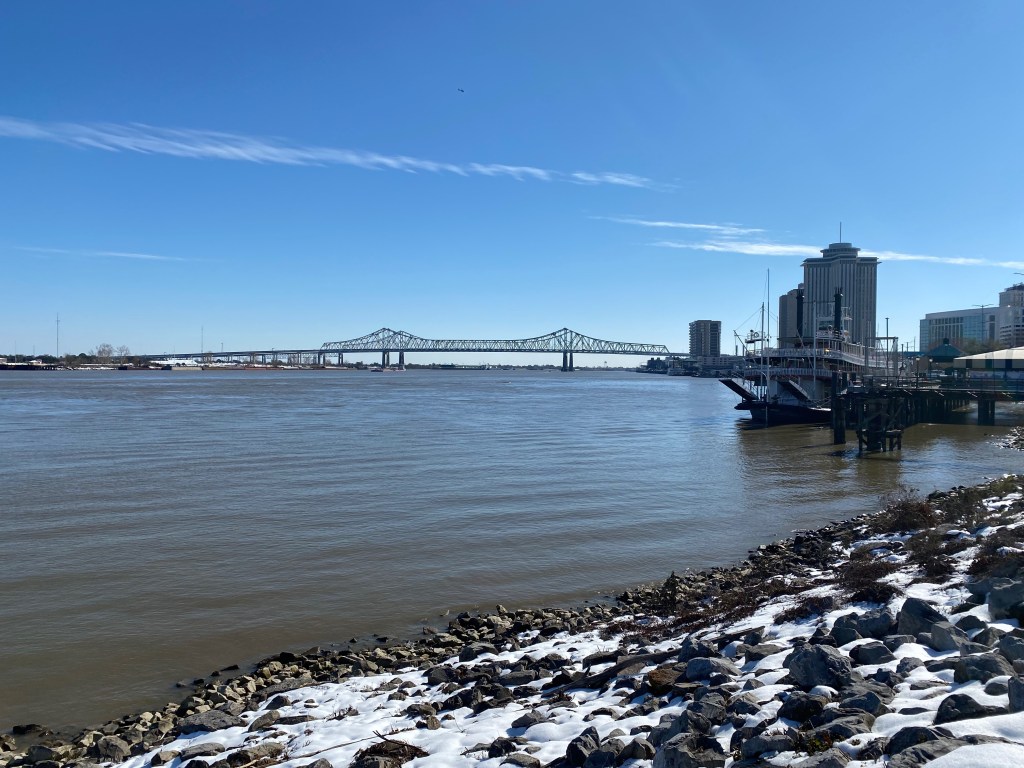
I went to New Orleans for the first time earlier this year. I’ve been to plenty of places that I visit once and then leave behind—glad I went, but not determined to return.
New Orleans was different. I’m certainly not the first person to say this: the city is famous for drawing people in and compelling them to stay, even when they know they could find more opportunities and less frustration elsewhere.
Still, I was surprised by how strong I found the pull of New Orleans. Not to the point of engineering a move there—I still love Michigan too much to leave!—but definitely enough that I’ve been looking at my calendar and thinking about when I might go back.
In the meantime, I’ve been reading about the city, absorbing its history and culture through the words of writers who have found New Orleans similarly engrossing. Below, you’ll find my short write-ups of several books on general New Orleans topics; come back on Thursday for a post devoted to volumes about Hurricane Katrina and its aftermath.
New Orleans is all kinds of unfathomable, a city of amorphous boundaries, where land is forever turning into water, water devours land, and a thousand degrees of marshy, muddy, oozing in-between exists; where lines that elsewhere seem firmly drawn are blurry; where whatever you say requires more elaboration; where most rules are full of exceptions the way most land here is full of water.
— Rebecca Solnit and Rebecca Snedeker, Unfathomable City: A New Orleans Atlas
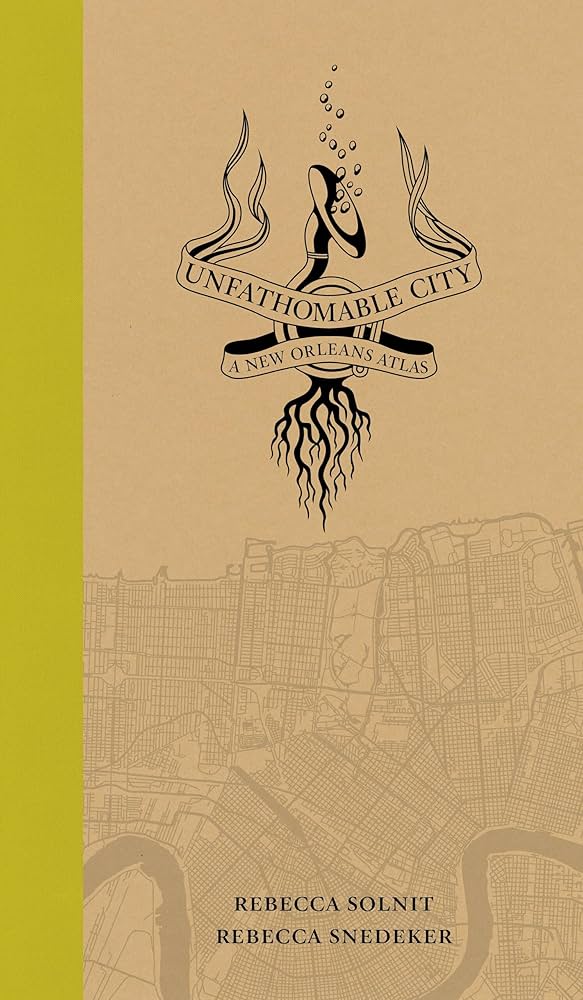
An atlas, we generally learn in elementary school, is a book of maps. There are the basic political maps, showing the boundaries between countries and states, with capitals and major cities marked. Topographic and physical maps highlight the important features of a landscape, like valleys and mountains. Road maps show roads, climate maps show information about climate. Maybe it’s been a while since you last opened an atlas, but you probably have a general sense of what one looks like.
Unfathomable City is a very different sort of atlas—one that tells a jumble of stories about New Orleans. Editors Rebecca Solnit and Rebecca Snedekar worked with dozens of writers, researchers, illustrators, and cartographers to create an atlas that shows far more than city streets or popular tourist sites. Twenty-two maps illustrate for readers important facets of the city’s people and its history, each with accompanying text (mostly essays, but some oral history interviews as well) to explain the significance of the map’s topic.
“Sugar Heaven and Sugar Hell,” for example, marks key sites in New Orleans’s history as a center of sugar production, sale, and consumption. There are places I expected, such as the plantations where enslaved people grew and refined sugar, the Domino Sugar processing plant, and Café du Monde, where every surface bears residue from the powdered sugar that blankets its beignets. But Shirley Thompson’s essay and the map by Shizue Seigel also identify locations that convey the knock-on effects of this sugar economy: the New Orleans Museum of Art, “founded with gift from Jamaican-born sugar broker Isaac Delgado”; the Superdome, which hosts the Sugar Bowl football game; the dialysis centers that treat patients whose kidneys have been damaged by diabetes. Sugar helped build New Orleans into a center of business and trade and is a key ingredient in many famous New Orleans recipes, but for centuries it has also destroyed so many of those who produce and consume it.
Other maps and essays celebrate the unique culture of New Orleans. “Thirty-Nine Sundays” immerses the reader in a second-line parade organized by one of the city’s largely Black social clubs, its accompanying map laying out the parade route each club takes and showing how they’re clustered in certain areas. Joel Dinerstein, a Tulane University professor and member of the Prince of Wales Social Aid & Pleasure Club, brings readers along as the club gathers on its designated Sunday in October, members attired in spiffy peach suits with olive-green accessories. They begin with a church service and group photo, then assemble for the main event. Winding through four miles of city streets with a brass band in the lead, the Walers (the “first line”) stroll and dance, picking up the “second line” as they go—spectators and passers-by who are moved to jump in and get down with the music. “A second-line parade is an annual house party that moves lightly like the feathers on our fans yet inexorably like a tank through the streets,” Dinerstein explains, conveying as best he can the feel of something I think one really has to experience to appreciate.
I carried Unfathomable City around New Orleans with me for days, the two- to five-page essays the perfect length to read while I waited for a streetcar or during the time it took for my order to arrive in a restaurant. A blend of guidebook, history, and memoir, the book is so much more than an atlas. It layers people, places, and stories one atop the other in a fascinating kaleidoscope of ways to understand New Orleans.
Jean-Baptiste Le Moyne, Sieur de Bienville, was still a teenager when he first traveled down the Mississippi River from his birthplace in Canada at the turn of the 18th century. Legend would have it that Bienville immediately recognized the value of the site that would become New Orleans—and perhaps he did. But the French crown didn’t hurry to act on whatever foresight Bienville might have possessed. Representatives of the expanding empire built settlements in several locations on the Lower Mississippi, including present-day Mobile, Alabama and Biloxi, Mississippi, before finally declaring Bienville’s New Orleans to be France’s “principal town” in the region in 1721. Perhaps unsurprisingly, Bienville had more to gain than mere acclaim. “Bienville fought for [the city’s] present-day location because he had large land concessions there,” historian Lawrence N. Powell observes. “Geopolitical clairvoyance had little to do with his site selection; self-interest, everything.”
The Accidental City: Improvising New Orleans, Powell’s 2012 history of New Orleans’s first century, is filled with similar moments of self-interest guiding the course of history. Self-interest was, indeed, the only thing the city had going for it in those early years:
The site was dreadful. It was prone to flooding and infested with snakes and mosquitoes. Hurricanes battered it regularly. Pestilence visited the town almost as often. But New Orleans’s situation—its strategic location near one of history’s great arteries of commerce—was superb.

Slowly and haltingly, New Orleans grew throughout the 18th century, first as a French city before being transferred to Spanish dominion in 1763. Bienville and his successors sought to impose order on their settlement, designing a tidy grid of streets adjacent to the river, but nature often forced a change of plans. Storms and floods were frequent occurrences, leading the new New Orleanians to build levees and plan canals in the wake of such disasters. “Solutions to foreseeable problems usually surfaced as afterthoughts,” Powell notes. “The improvisational style was characteristic of many frontier communities. Early New Orleans raised it to an organizational principle.”
Powell lays out how New Orleans came together, not just geographically and physically, but economically, politically, and socially as well. Three trading networks—the Atlantic, the Caribbean, and the frontier—overlapped in the city, contributing to its lively and syncretic culture. “The frontier of fresh starts” absorbed newcomers seeking to reinvent themselves and maybe build a fortune while doing so; smuggling and many other illicit trades flourished and gave the city a far-reaching reputation for its saucy disregard for the law.
Of course, large numbers of New Orleans’s residents did not voluntarily settle there. Enslaved Africans literally built the city, toiling on drainage and road construction sites. White men coerced Black enslaved women into sexual relationships. (The willingness of those men to then manumit the women and their children was one reason a significant number of free Black residents also lived in New Orleans, their population reaching 20 percent of the city’s by 1791.) Louisiana grew as a locus of sugar and cotton production, the economic vitality it derived from these two labor-intensive crops leading to ever-greater demands for more enslaved persons to produce them on the area’s plantations. Structures of race and class power established in the city’s first century linger to the present day.
France re-acquired New Orleans from Spain in 1803 but then relinquished the asset almost immediately, selling it off to the United States as part of the Louisiana Purchase. Even as it was absorbed into the growing nation, however, New Orleans remained unique. It retained the food, architecture, legal code, and language of its century under French and Spanish rule; its people resisted the pull of assimilation. New Orleans, Powell writes,
became a state of mind, built on the edge of disaster, where the lineages of three continents and countless races and ethnicities were forced to crowd together on slopes of natural levees and somehow learn to improvise a coexistence that might be America’s only original contribution to world culture.
Twenty-first century New Orleans plasters its tourist districts with the declaration Laissez les bon temps rouler!, a catchphrase inviting visitors to go wild in the city. Powell’s book, however, elucidates the history behind this attitude, taking it from a marketing slogan to an understandable approach toward life, with roots stretching to the earliest days of New Orleans. In the face of contingency, uncertainty, and the need for frequent improvisation, who wouldn’t let the good times roll?
While free Black residents of pre-Civil War New Orleans were not enslaved, their lives were not necessarily secure or safe. White New Orleanians worried that free Blacks would foment uprisings among enslaved people and regarded the group with apprehension. Free men and women were vulnerable before the law, especially if they could not produce clear documentation proving their non-enslaved status. But at 20 percent of the city’s population, there could be a certain amount of safety in numbers. By the early 19th century, free people of color began to form mutual aid groups.
One such group, the Société d’Economie et d’Assistance Mutuelle, is the subject of Economy Hall: The Hidden History of a Free Black Brotherhood, by New Orleans author Fatima Shaik. “One evening in the 1950s,” Shaik relates, “my father rescued a small library of rare books from the back of a pickup truck.” The books were the handwritten meeting minutes of the century-old Economie, which was disbanding in the face of dwindling membership, and Shaik’s father carefully stored them in the family’s home. Decades later, Shaik began to read the journals and quickly found herself absorbed in the community stories that she found inside. Economie members established schools for Black children and, after the Civil War, sought to ensure voting rights for men of color. These volumes, Shaik realized, “expanded the narrative of Blacks as active participants in the major social and political events of the United States and offered additional information about their terms of engagement.” They were unparalleled documentary records, written in real time by direct participants in events.
A large portion of the journals were written by one man, Ludger Boguille, a schoolteacher who served as Economie secretary and recorded detailed notes in “a decorative, almost jewel-encrusted script.” Shaik uses Boguille’s life story as a way to focus her history of the Economie and the free Black community in New Orleans. Born in 1812 to parents who had left Haiti in the wake of revolution, Boguille received a classical education and opened a school; he became an Economie member around 1852. Gaining membership was not simply a matter of putting one’s name forward, as the other Economistes carefully vetted prospective brothers:
They depended upon one another for dues, which paid for their medical and burial expenses as well as their banquets. The Economie also wanted men who would come to meetings on time and willingly dig deep into their pockets for charity, such as providing aid to the blind, widows, and orphans
In addition to the aid it provided members in difficult times, the Economie offered them a social outlet. Economy Hall, the group’s clubhouse (opened in 1857), hosted annual banquets and frequent dances; in the 20th century, it would gain renown as “one of jazz’s most famous incubators.” (A young trumpeter named Louis Armstrong got his start with a gig at Economy Hall.)
Boguille and his fellow Economistes took an active role in the post-Civil War fight to secure civil rights for people of color in New Orleans. Their efforts, however, provoked violent retaliation from white residents who refused to accept that Black citizens now had equal rights under the law. This section of Shaik’s book provides a vivid look at how Reconstruction played out, and failed, on the ground.
Toward the end of the 19th century, the Economistes took a step back from their political activities and re-focused on the community-building aspects of their organization. They became less selective in admitting new members, and the minutes (no longer kept by Ludger Boguille, who died in 1892) were now written by secretaries whose handwriting “showed less flourish and precision.” By 1914, the records were kept exclusively in English, rather than the French that had dominated the Economie in the 19th century. Funeral homes and insurance companies began to supplant the mutual-aid work once provided by the Economie. The group dissolved in 1957, and Economy Hall was destroyed by Hurricane Betsy in 1965.
In reading the Economie notebooks, Shaik realized that the stories they told were the history of the neighborhood in which she had grown up. “I found Société d’Economie surnames among my neighbors,” she writes, “such as Rouzan, Bagniers, Boutte, Charbonnet, Barthelemy, and Martinez, and extended family members Bart and Boguille. At once, I saw that the journals corroborated the oral history that my community maintained—and American history excluded.” The events of Economy Hall took place many generations ago, but the community of the Economie endures.
I visited a used bookstore on Orleans Street in search of books about New Orleans East. The owner told me there were none. The East, he said, was too young for history.
In the early 1960s, New Orleans East was supposed to be the next big thing. Real estate developers from Texas bought up a huge cypress swamp and set about draining the soft, wet ground, then covered it with houses. They spoke grandly of the one million residents that the neighborhood would contain by 1970, supported by jobs at the nearby NASA rocket-building facility or Folgers Coffee plant. New Orleans was booming, and people needed a place to live. Developers offered New Orleans East as the answer.
Ivory Mae Webb, a 19-year-old widow about to bear her third child, used the money from her deceased husband’s life insurance policy to buy a house in New Orleans East in early 1961. But the house that Ivory Mae bought wasn’t fresh and new; it would take three years of work before her family could move in, then demand constant upkeep and renovations in the decades that followed. In those decades, the early promise of New Orleans East would dissipate as the city stopped growing and no longer needed space to expand. But NASA and Folgers remained, as did thousands of families that had made their home in the East.
Ivory Mae’s was among them. She soon remarried and had more children with her second husband, Simon Broom, eventually creating a blended family of 12 kids. The youngest of them, Sarah, was born in late 1979, six months before Simon died suddenly of a brain aneurysm and left Ivory Mae to handle the house on her own.

Sarah M. Broom weaves together the stories of her family, their home, and New Orleans East in The Yellow House, her 2019 memoir. Broom grew up aware of the self-consciousness Ivory Mae felt about the house; no matter how carefully she decorated or how frequently she cleaned, Ivory Mae couldn’t overcome the structure’s shortcomings. Simon had a tendency to start projects but leave them unfinished, and his death meant that walls would forever remain mere framing and cabinets would never get doors. The plumbing and electricity were both temperamental. Ivory Mae discouraged her children from bringing outsiders home, frequently reminding them, You know this house not all that comfortable for other people. Sarah and her siblings got the message.
Yet despite its increasingly ramshackle nature, the Yellow House was still their family home; despite its failed promise, New Orleans East was still their neighborhood. In The Yellow House, Broom has written that history of New Orleans East that the bookstore owner told her didn’t exist. Less than ten miles from the tourist attractions of the French Quarter and Garden District, the East is part of the city that few visitors see—“except for the disaster bus tours that became an industry after Hurricane Katrina, carting visitors around, pointing out the great destruction of neighborhoods that were never known or set foot in before the Water, except by their residents.”
The Yellow House is more than an account of Hurricane Katrina, but the storm is the greatest force in Broom’s story. A journalist in New York by that point, Broom was not present for the hurricane and could only keep in touch with her family, intermittently, from afar. Her mother and siblings scattered—to Texas, California, Alabama—and some have never returned to New Orleans. And none returned to the Yellow House, which the city condemned and razed after the hurricane. Ivory Mae, with Broom’s help, would spend seven years applying for compensation before the funds finally came through. Half a century after moving to New Orleans East, Ivory Mae signed away the land and relinquished the property that she had bought and made her family’s home.
“The Yellow House was witness to our lives. When it fell down, something in me burst,” Broom writes. She spends the years following the house’s demolition working to sort out and narrate its role in her family’s story—how a place that had invoked feelings of shame was also a stable center, a homestead where they could always gather. New Orleans East never became the “Model City” that its developers hyped. But for Broom’s family, the Yellow House became a home.
Similar to The Yellow House, Nine Lives: Mystery, Magic, Death, and Life in New Orleans starts years before Hurricane Katrina, narrating decades of personal histories in New Orleans before a final section focused on the disaster. Journalist Dan Baum, however, was not a native of the city like Sarah Broom. He arrived in New Orleans on August 31, 2005—two days after Katrina hit—on assignment for The New Yorker to write about the hurricane’s impact on the city and its people.
To Baum’s credit, Nine Lives is not a work of parachute journalism. He immersed himself in New Orleans (he moved to the city for a period of time) and figured out that the way to tell the story of Katrina was to tell the story before Katrina.
Starting in 1965 (the year of Hurricane Betsy, another pivotal storm), Baum recounts the lives of—you guessed it—nine people from across the city. There’s Frank Minyard, the jazz-playing coroner, and Billy Grace, an upwardly mobile lawyer who married into the old-money Uptown establishment. Ronald Lewis spent decades working on streetcar maintenance crews, then created a museum in his backyard devoted to the Lower Ninth Ward’s Mardi Gras Indians. Wilbert Rawlins, Jr. dedicated himself to at-risk high-school students as their band teacher. Belinda Carr dreamed of going to college and living in a house with a white picket fence; Joyce Montana helped her husband sew his elaborate costumes for each Mardi Gras performance. John Guidos suffered in secret for years before he could live openly as JoAnn, while Anthony Wells (the only one who tells his story in first person) moved in and out of prison. The one figure I could have done without was Tim Bruneau, a rigid cop who seemed to despise the people he was meant to protect—I really didn’t need to spend any time in his head.
Baum (who died in 2020) composed Nine Lives in short, tight chapters that never linger on a single character for long. It takes a bit of time to start putting the pieces together and get into the book’s flow, but Baum reassured readers in the preface not to stress too much:
Nine separate stories is a lot to keep straight. Don’t worry if, for the first fifty pages or so, you can’t remember who’s who. These chapters were written to be enjoyed as individual stories. Everybody will fall into place eventually. In other words, be a little bit New Orleanian about reading this book. Don’t stress over achieving anything. Just have a good time. It will all work out in the end.
Feature photo: The Mississippi River at New Orleans, January 23, 2025.
 Maura Elizabeth Cunningham
Leave a comment