
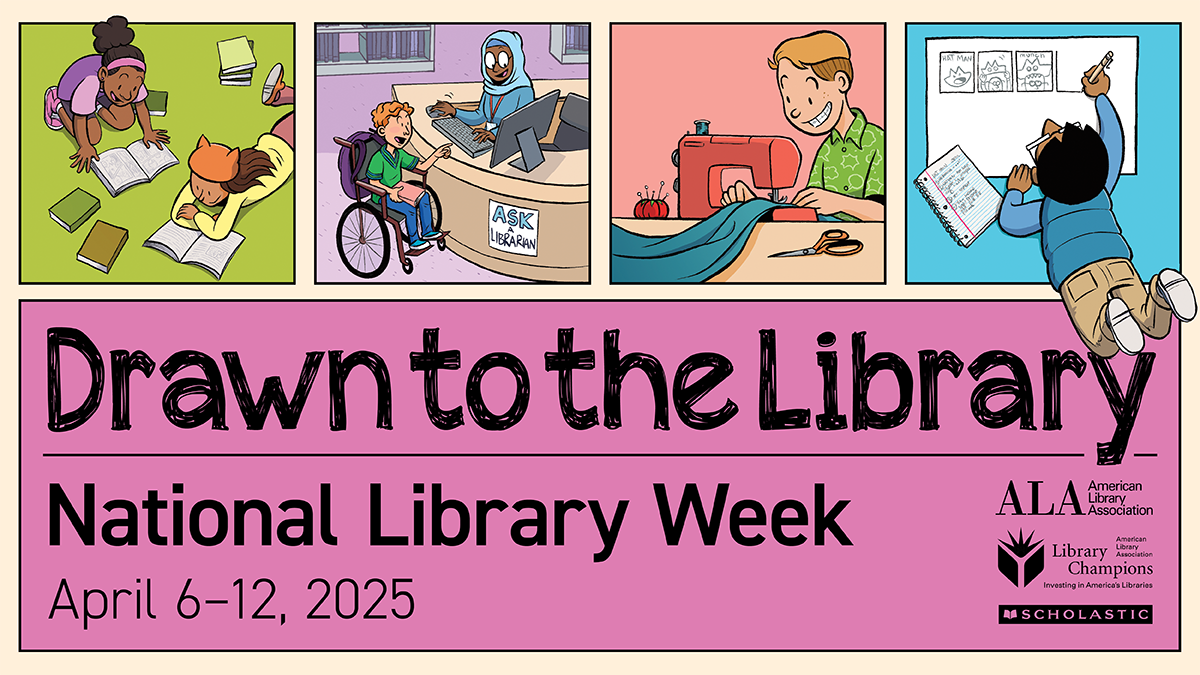
Today marks the launch of National Library Week. It’s probably not a surprise that I love libraries: how else could I ever afford to support my reading habit? Each time I’ve moved to a new place, getting a new library card is one of the first things I do to get settled. Even when I’m traveling I often seek out libraries—they’re the perfect (free!) place to take a break, use the restroom, and absorb a bit of the local vibe.
I am, in other words, “Drawn to the Library,” as this year’s National Library Week posters proclaim, and I always have been. My Aunt Marge and Uncle Dick were both lifetime Free Library of Philadelphia employees, and on occasion they would take me to their offices at the Central Library, giving me a chance to see library work behind the scenes. For years, Monday evenings were library night—my mother took my brother and me to the Free Library branch in our neighborhood to stock up on books and VHS tapes; eventually, I got old enough to walk there on my own (especially nice in the summer during the years when the library had air conditioning and our house did not). My first job was at that library in the late 1990s, when the branch got 20 or so computers and hired several “Teen Tech Assistants” to help patrons use them (even though I don’t think any of us knew much more about computers than the people we were helping).
National Library Week takes on a special importance this year because libraries—like so many institutions across the country—face an uncertain future. DOGE has halted the work of the Institute of Museum and Library Services, which provides funding and support to libraries throughout the United States. Right-wing groups are constantly fighting to ban books. One tiny library is even caught up in tensions at the U.S.-Canada border.
Many librarians have been doing great work despite minimal resources for years, but they need support. That could be money, and money is certainly helpful. But I think our voices are even more important right now, especially in telling elected representatives that they need to protect library funding. Ensuring that public libraries have the resources they need to be healthy and vibrant community institutions is the best way I can think of to honor them during National Library Week.
Thanks for joining me this week. 📚
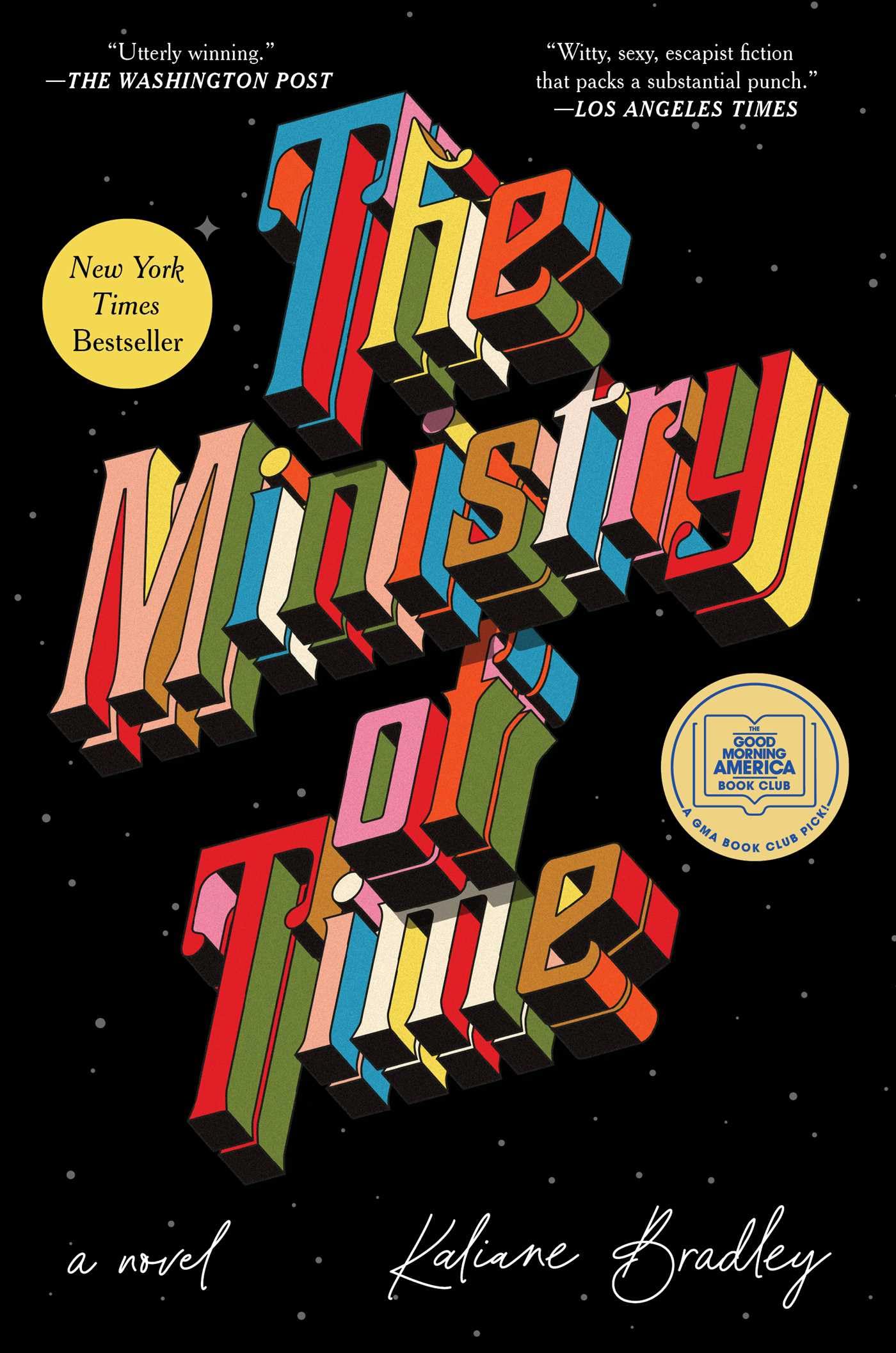
New Goodreads Review
Recommendations
China Stories
Keith Bradsher, “Why China Is Wary of a Trump-Xi Summit”
Damien Cave and Muktita Suhartono, “Why Was This the Only High-Rise in Bangkok to Topple After the Quake?”
Dake Kang, Matthew Lee, and Didi Tang, “US bans government personnel in China from romantic or sexual relations with Chinese citizens”
Andrew Stokols, “Revitalizing China’s Urban Villages through Community Gardening”
Kevin Wang, “Florida college fires Chinese professor under state’s ‘countries of concern’ law”
Wanderings Around the World
The church and cemetery are almost all that is left from this little-remembered event in Ugandan — and African — history, when the country took in over 7,000 displaced people in total from Poland between 1942 and 1948. They lived in relatively isolated communities in remote settlements, far removed from European expatriates already living in Uganda. With the help of African laborers, they built their own schools, hospitals and church, constructing self-sufficient communities that were managed by the British protectorate government and guarded by African soldiers.
— Anna Adima, “The Untold Story of Polish Refugees in Uganda”
Kaamil Ahmed, “New images reveal extent of looting at Sudan’s national museum as rooms stripped of treasures”
Hannah Beech and Edward Wong, “Trump’s U.S.A.I.D. Cuts Hobble Earthquake Response in Myanmar”
Elizabeth Blair, “Cultural groups across U.S. told that federal humanities grants are terminated”
Museums offer cautionary tales, hard lessons about where the country has been and where we hope to never be again. They hold a great deal of public trust, perhaps more than schools, media, newspapers or even films. Patrons get to experience first hand documents, letters, original photographs and artefacts. Museums are public time capsules of where we have been. I will never forget seeing Emmett Till’s casket, Harriet Tubman’s shawl, Nat Turner’s Bible or an early flag of the First Republic of Haiti. These artefacts do more than defy the odds by still existing; they tell a powerful story about who people were during the times that they lived. Museums should not be party to culture wars. Our history is a collective memory whether Trump likes it or not.
— Kellie Carter Jackson, “Trump will not stop until every American relic reflects his imaginary world view”
Helen Davidson and Chi-hui Lin, “An unexplained death, ‘abuse and slavery’: Indonesian fishers reveal life on long haul vessels”
Michael Koncewicz, “The Alarming Effort To Rewrite the History of Watergate”
Erin L. Murphy, “Compounding Devastation: The Myanmar Earthquake”
“African Americans are a part of American history,” Bri’Anne Wright, a 35-year-old from California, said after exploring the museum with her mother. “There’s no way this is anti-American if it’s showing everything we’ve been through and what our nation is founded on.”
— Emma Uber and Gaya Gupta, “Trump’s executive order targeted this museum. Many visitors question why.”
Karin Wulf, “The Humanities as Canary: Understanding this Crisis Now”
Standout Story
April 4 was the 57th anniversary of the assassination of the Reverend Dr. Martin Luther King, Jr. in Memphis, Tennessee. In 2023, Atlantic journalist Vann Newkirk released Holy Week, an eight-episode podcast that recounts what happened in the days following King’s death. Newkirk speaks with activists in the civil-rights movement, former Johnson Administration staff members, and residents of cities that erupted into uprisings after the assassination. Holy Week is a masterful examination of how a national event affected individual lives.
Featured photo: Parkway Central Library of the Free Library of Philadelphia, 2013. Photo by Beyond My Ken, sourced via Wikimedia.
 Maura Elizabeth Cunningham
Leave a comment