
Baseball is back! Amid a constant deluge of news about the Trump Administration’s infuriating decisions, anxiety-producing moves, and ridiculous justifications for both (see links below for all of the above), I’m making space in my schedule for Phillies games and holding on to the hope that this is the year they manage a World Series victory. They’re 2-0 to start the season, so my hope remains strong.
Thanks for joining me this week.
Recommendations
China Stories
Although careful diplomacy might let China pocket some short-term tactical successes, however Beijing plays its cards, the difficulty of winning over the deeply suspicious United States and Europe make it unlikely that Beijing will achieve lasting strategic gains in either relationship. It is in the rest of the world—in Latin America, Africa, and Asia—that China is most likely to reap the diplomatic benefits of U.S. retrenchment.
— Jude Blanchette, “China Sees Opportunity in Trump’s Upheaval”
Keith Bradsher and Meaghan Tobin, “A Montana Senator Seeks to Be Trump’s Voice in Beijing”
Finn Lau thought he had escaped China’s reach when he got to London. He’d come from Hong Kong, where Chinese authorities were rapidly consolidating control. An extensive protest movement had sprung up in response, which Lau was helping to lead. But he fled after local officials arrested him at a pro-democracy demonstration in 2020. Months later, while he was walking down a quiet street in London, three masked men jumped him and beat him unconscious. Now 31, Lau still has a faint scar on his boyish face.
— Cora Engelbrecht, with photographs by Emily Garthwaite, “Leaving Hong Kong Wasn’t Enough”
Ian Johnson, “The Chinese Communist Party’s Ultimate Taboo”
Lingua Sinica, “A River Crisis Prompts Rare Coverage”
Lingua Sinica, “Survival Beyond Silence”
Zhaorui Lü, “Navigating the Market for Love: The Chinese Party-State as Matchmaker in the Early Reform Era”
In February, 1885, an errant bullet from a dispute between rival Chinese factions in the town of Eureka, California, killed a white city councilman. Angry white residents banded together and forced more than three hundred Chinese people to leave town. This turned out to be the opening act of a harrowing period in American history that became known as “the driving out,” when dozens of communities expelled their Chinese residents. But the expulsions did not begin immediately. There was an interregnum, during which the fury over Chinese immigration seemed to be largely contained. Then, in September, 1885, in Rock Springs, the fury spilled over.
— Michael Luo, “When an American Town Massacred Its Chinese Immigrants”
James Palmer, “Did China Get Billionaires Right?”
Christian Shepherd and Vic Chiang, “This Chinese city grew its birth rate. It won’t be easy to copy.”
Wanderings Around the World
Allyson Chiu, “This muggy city keeps cool with minimal AC. Here’s how.”
Choe Sang-Hun, “World’s Largest ‘Baby Exporter’ Admits to Adoption Fraud”
Aishvarya Kavi, with photographs by Eric Lee and Kent Nishimura, “Showdown at the Institute of Peace”
E. Tammy Kim, “The Government’s Rock Librarian”
Amitava Kumar, “Travelling Through India on the Himsagar Express”
IMLS was established by the Republican congress in 1996, combining the National Commission on Library and Information Science and the Institute of Museum services in the Museum and Library Service Act, which was renewed in 2003 and again in 2010. It’s an independent federal agency with about 75 full-time employees with a budget of around $300 million. For an agency that operates across the entire US, that is miniscule. To put that in perspective locally, the Ann Arbor Fire Department, that serves a community of about 125,000 residents across 28 square miles has 88 employees. The Ann Arbor Public Schools serve about 17,000 students with a staff of 2,000 employees and have an annual budget of around $300 million.
— Eli Neiburger, “What IMLS Does”
Frances Robles, “Trump Did What Castros Couldn’t: Take Radio Martí Off the Air”
Manuel Roig-Franzia, Kyle Swenson, Emma Uber, and Gaya Gupta, “Trump order launches Smithsonian and its visitors into confusion, dismay”
Kevin Rushby, “Fears for Bagan’s towering Buddhist temples after Myanmar earthquake”
Kyle Swenson, “Their jobs vanished. These historians want to ensure their stories don’t.”
Chloe Veltman, “Report: (Smaller) Museums should make admission free” (audio)
Sarah Ventre, “Exhibit takes visitors inside the annex where Anne Frank lived”
Standout Story
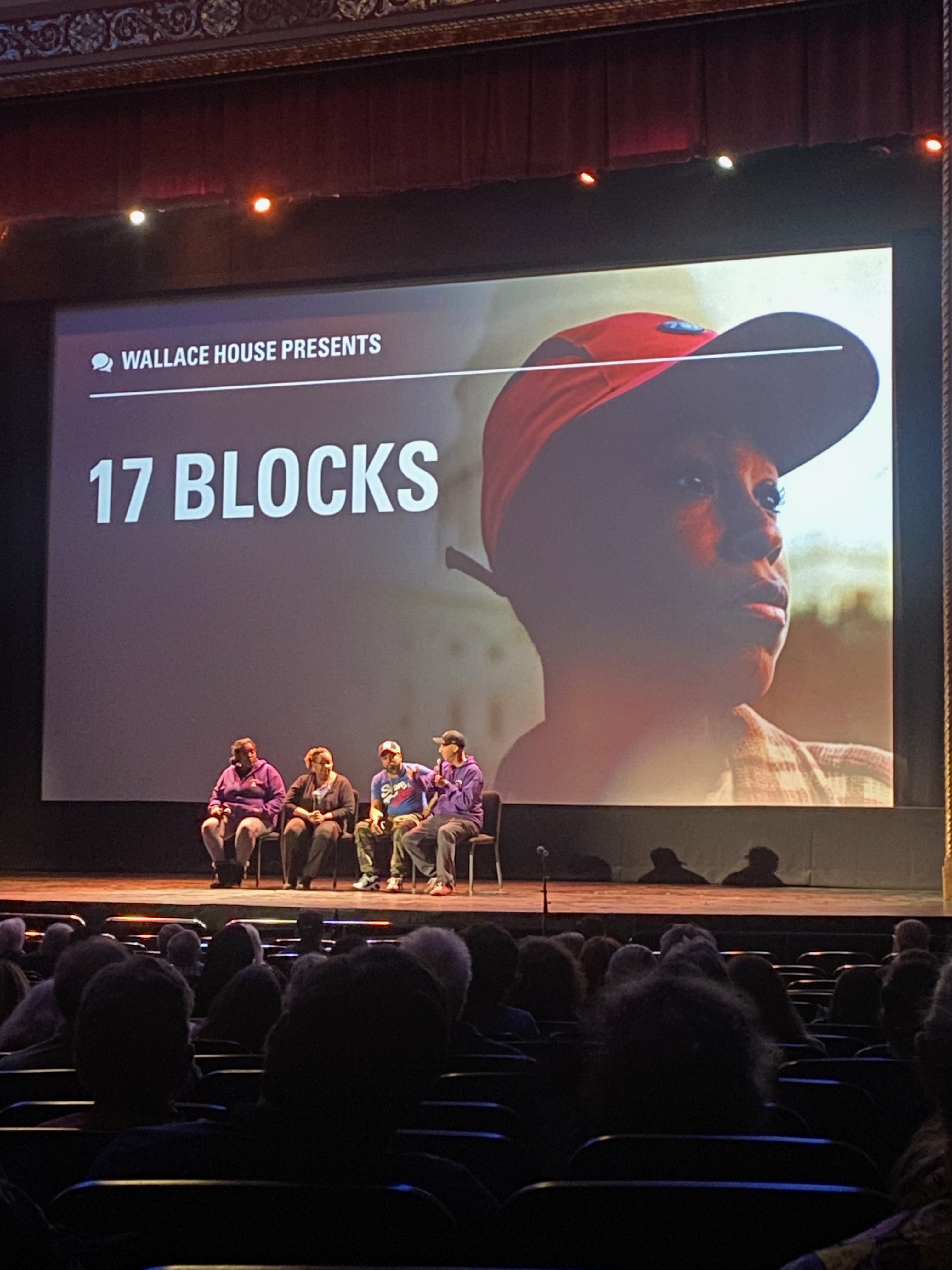
Two weeks ago, I attended a special screening of 17 Blocks at the Michigan Theater. The documentary didn’t start out as one: aspiring filmmaker and Ann Arbor-native Davy Rothbart was just fooling around with a video camera in 1999, making home movies with the Sanford family—three kids and their mother, who had befriended Rothbart after he moved to Washington, D.C. A decade later, however, the tone of the recordings changed when the youngest Sanford son was shot and killed, the victim of a robbery at the family’s home. In the midst of their grief, Cheryl Sanford, her daughter, and son wanted to keep filming and create a record of what gun violence does to a family and their community. They continued working with Rothbart for another decade, generating over a thousand hours of footage that chronicles their grief and hope and attempts to prevent such tragedy from touching other families.
17 Blocks is a powerful film, made even more so by the Q&A that followed the screening, which featured Rothbart in conversation with the Sanford family. The documentary doesn’t appear to be streaming anywhere right now, unfortunately, but if you have the opportunity to catch a screening, I highly recommend it.
Featured photo: The Detroit Tigers play the Baltimore Orioles at Comerica Park, July 31, 2021.
 Maura Elizabeth Cunningham
Leave a comment