We’ve once again arrived at my least favorite Sunday of the year: the start of Daylight Savings Time. I hate losing an hour—yes, I know I’ll get it back in the fall, but I need that hour TODAY. I especially need it because this upcoming week is AAS Annual Conference week, meaning my colleagues and I have been working nonstop to host an event for 3,000+ people. It’s the highlight of our year, but quite a production.
I’m leaving for Columbus, Ohio on Tuesday morning and will be there until next Sunday—if you’re coming to AAS, please say hi.
Thanks for joining me this week.
Recommendations
China Stories
Hannah Beech, “On a Lawless Tropical Border, the Global Scam Industry Thrives”
Noah Berman, “China Hawks Stop Squawking”
Joy Dong and Daisuke Wakabayashi, “The ‘Leniency’ Trap: How China’s Plea System Gives Prosecutors More Power”
The Economist, “Who works where, doing what, in China”
For Western scholars of China, the era before the pandemic now feels like a distant golden age. Despite always tight Chinese information controls and opaque policymaking, academics could still visit the country, navigate archives, cultivate relationships with their Chinese counterparts and pursue research. The resulting academic findings were good for America: For decades, U.S. government agencies regularly called on scholars — and still do — to provide briefings and testimony and to mine their research for insights that were vital to informing American policy decisions.
— Yanzhong Huang, “America Is Dangerously Ignorant of What’s Going On in China”
Panu Wongcha-um, “Canada and US offered Uyghurs in Thailand asylum before deportation to China, sources say”
Amy Qin and Ana Swanson, “Professor, Scrutinized for Ties to China, Sues to Get His Job Back”
My research shows that language politics in Tibet are surprisingly complex and driven by subtle violence, perpetuated not only by Chinese authorities but also other Tibetans. I’ve also found that outsiders’ efforts to help are failing the minority languages at the highest risk of extinction.
— Gerald Roche, “Tibet is one of the most linguistically diverse places in the world. This is in danger of extinction”
John Ruwitch, “China’s parliament opens with confidence about the economy despite tariffs, headwinds”
Christian Shepherd and Lyric Li, “Never mind Trump’s tariffs. The Chinese Communist Party remains defiant.”
Neil Thomas and Jing Qian, “What to Watch at China’s Two Sessions in 2025”
Vivian Wang, “The Secret Campaign in China to Save a Woman Chained by the Neck”
In 2008, the US Embassy in Beijing started regularly tweeting about the air quality in the city, which was gearing up to host China’s first Olympic Games. Two times a day, the embassy automatically published current pollution levels measured by an air quality monitor installed on its roof in collaboration with the US Environmental Protection Agency. The data contradicted the figures published by the local government, angering local officials and eventually spurring China to clean up the air in its capital city. But on Tuesday, a spokesperson for the US State Department told WIRED that the program is abruptly ending due to budget constraints.
— Zeyi Yang, “US State Department Kills Global Air Monitoring Program Researchers Say Paid for Itself”
Li Yuan, “Many Chinese See a Cultural Revolution in America”
Wanderings Around the World
Amy Elliott Bragg, “We could have had cable cars 🚠”
Sara Georgini, “How a Leading Black Historian Uncovered Her Own Family’s Painful Past—and Why Her Ancestors’ Stories Give Her Hope”
Buffy Gorrilla, “Long ignored, Black modernist architects get recognition” (audio)
Julian Lucas, “Dredging Up the Ghostly Secrets of Slave Ships”
Amanda Mull, “What We Lose When Our Memories Exist Entirely in Our Phones”
The monsoon is the single-most important weather phenomenon affecting the Indian subcontinent. Accurate forecasts are crucial for farming decisions and to predict inflation – a normal monsoon typically limits inflation, while deficit or excess monsoons can lead to high rates of inflation.
— Vaishnavi Rathore, “How Trump could hurt India’s ability to forecast the monsoon”
Emiline Smith, “Art Institute of Chicago Returns Sacred Buddha Statue to Nepal”
Briana Thomas, “After Decades, the Full African American Civil War Memorial Museum Is Finally Coming”
Dasl Yoon, “The North Korean Defector Who’s Been Called a ‘Hero of Ukraine’”
Standout Story
All of my grandparents were revolutionaries in the literal sense; they were activists, organizers, and spies. They operated amid the kind of violent tumult unimaginable to most of us and did unspeakable things to try to save their country and for their own survival. The personal price they paid – and continued to pay long after the revolution was over – is something that history books don’t make room for.
— Frankie Huang, “With violent revolutions, hope comes requisite with horror”
Catching Up
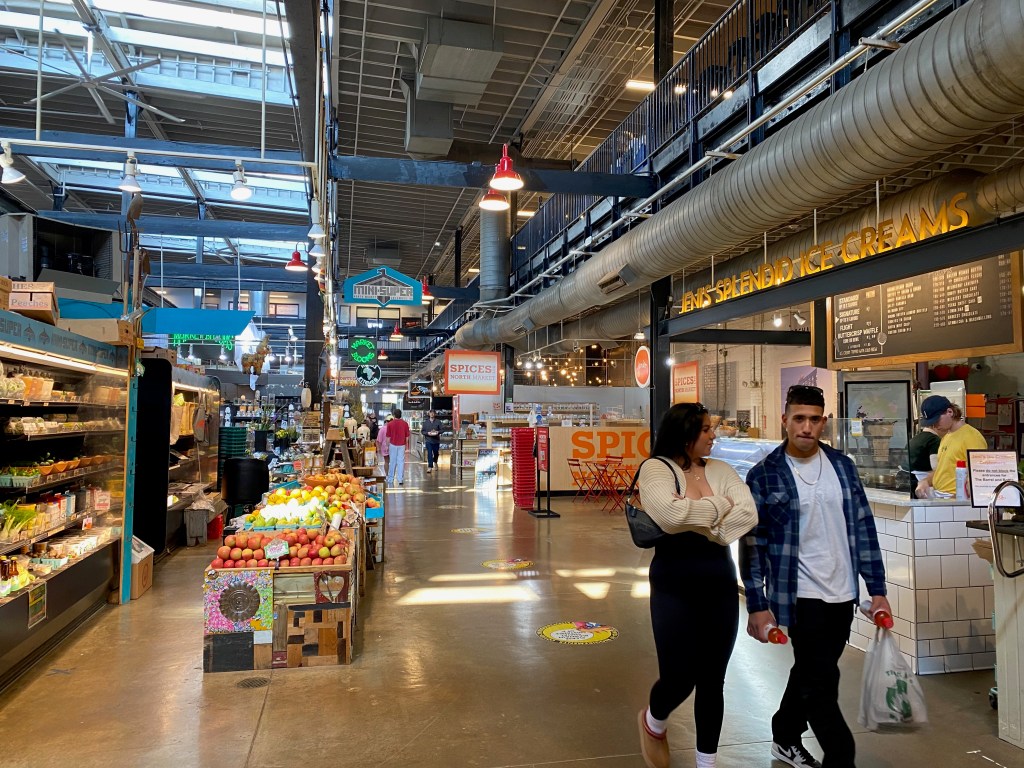
Featured photo: North Market, Columbus, Ohio, October 12, 2023.
 Maura Elizabeth Cunningham
Leave a comment