
I was supposed to leave New Orleans late Tuesday afternoon, but by Monday I knew there was little chance my flight would take off as scheduled. The forecast called for 4-5” of snow on Tuesday, in a place unprepared for those sorts of winter conditions. Schools announced closures, the mayor held a press conference, and everywhere I went people were talking—with a mix of dread, excitement, and awe—about what it would be like to get that much snow.
Sure enough, flakes were falling outside my hotel-room window at 8:00 AM on Tuesday, and shortly after that I got a text from Delta informing me that my flight was cancelled. I extended my stay for another night, worked in my room for a bit, and then ventured outside to find some food. Instead of encountering a gentle, picturesque snowfall, I was hit in the face by gusting winds and whipping snowflakes (plus the bitter cold that had settled on the city a few days before). I staggered halfway down the block to Daisy Duke’s and ordered two entrees to go—one for lunch, one for dinner. I wasn’t interested in making a second trip outside during a storm that was nasty by even my Michigan-hardened standards.
The sun shone down on the city Wednesday morning, bouncing off the ice that coated every surface. The official snowfall totals were between four and ten inches; the Central Business District and French Quarter seemed to be on the low end of that, but what had fallen had frozen. Hoping to find a restaurant open for breakfast, I walked with mincing, sliding steps down Bourbon Street. “I need ice skates,” I texted my brother once I arrived at the Royal Sonesta Hotel’s restaurant and nabbed a table. The place was jam-packed: with most dining spots closed, those that had managed to stay open struggled to keep up with the influx of business. Servers were constantly on the move, refilling coffee cups and assuring customers that their orders would be ready soon. It was an unscheduled dress rehearsal for Mardi Gras.

When Delta rescheduled me on a flight for Thursday afternoon, I fully expected it to take off as planned. The sunshine and warmer temperatures on Wednesday had melted most of the ice, and the city was gradually getting back to business. I packed my suitcase and tidied up the room—but then, the text came. “We’re sorry …” I unpacked.
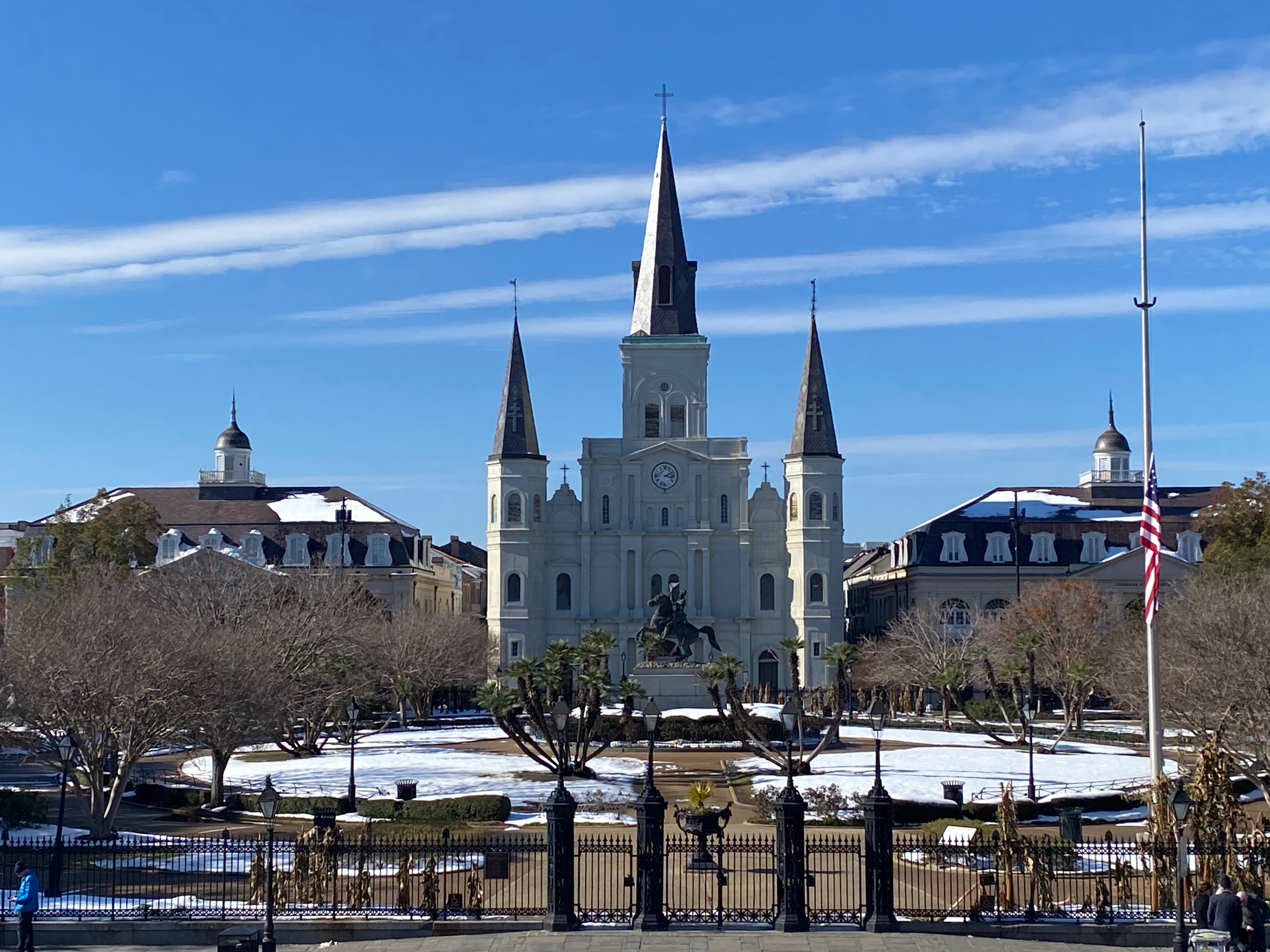
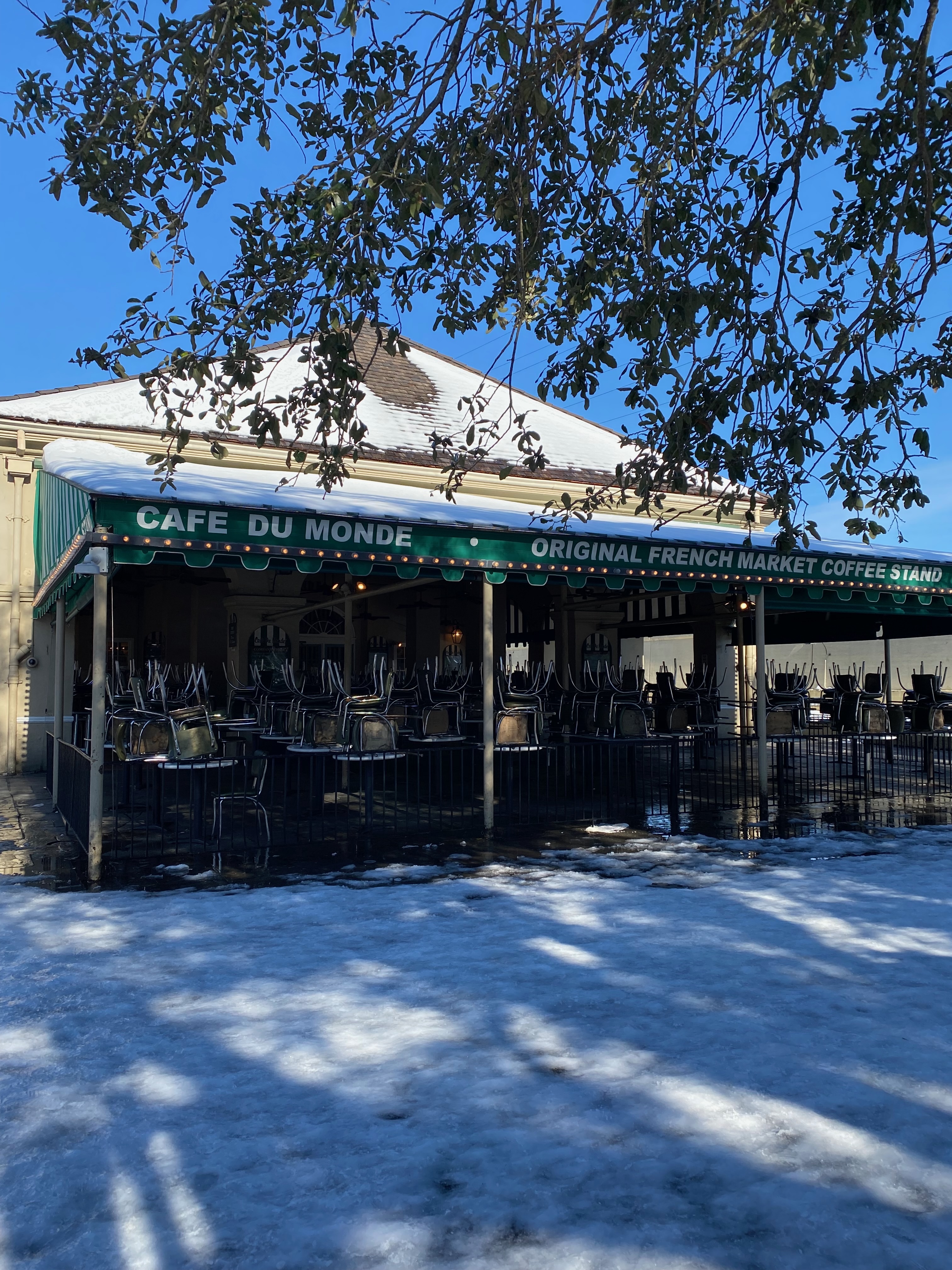
With most shops, restaurants, and tourist spots once again open, I took a few hours off from work on Thursday afternoon to see New Orleans in the snow one last time. I walked down to Jackson Square and purchased some gifts in a shop on Decatur Street. I popped into tiny, beautiful Faulkner House Books and browsed the shelves. I snapped photos of the snowmen that people had built and decorated with the accessories of New Orleans—Mardi Gras beads, liquor bottles, a cigar. Café du Monde was still closed, so I got a table at Café Beignet and drank café au lait while listening to a guitarist perform covers of Bob Seger and Elton John songs.

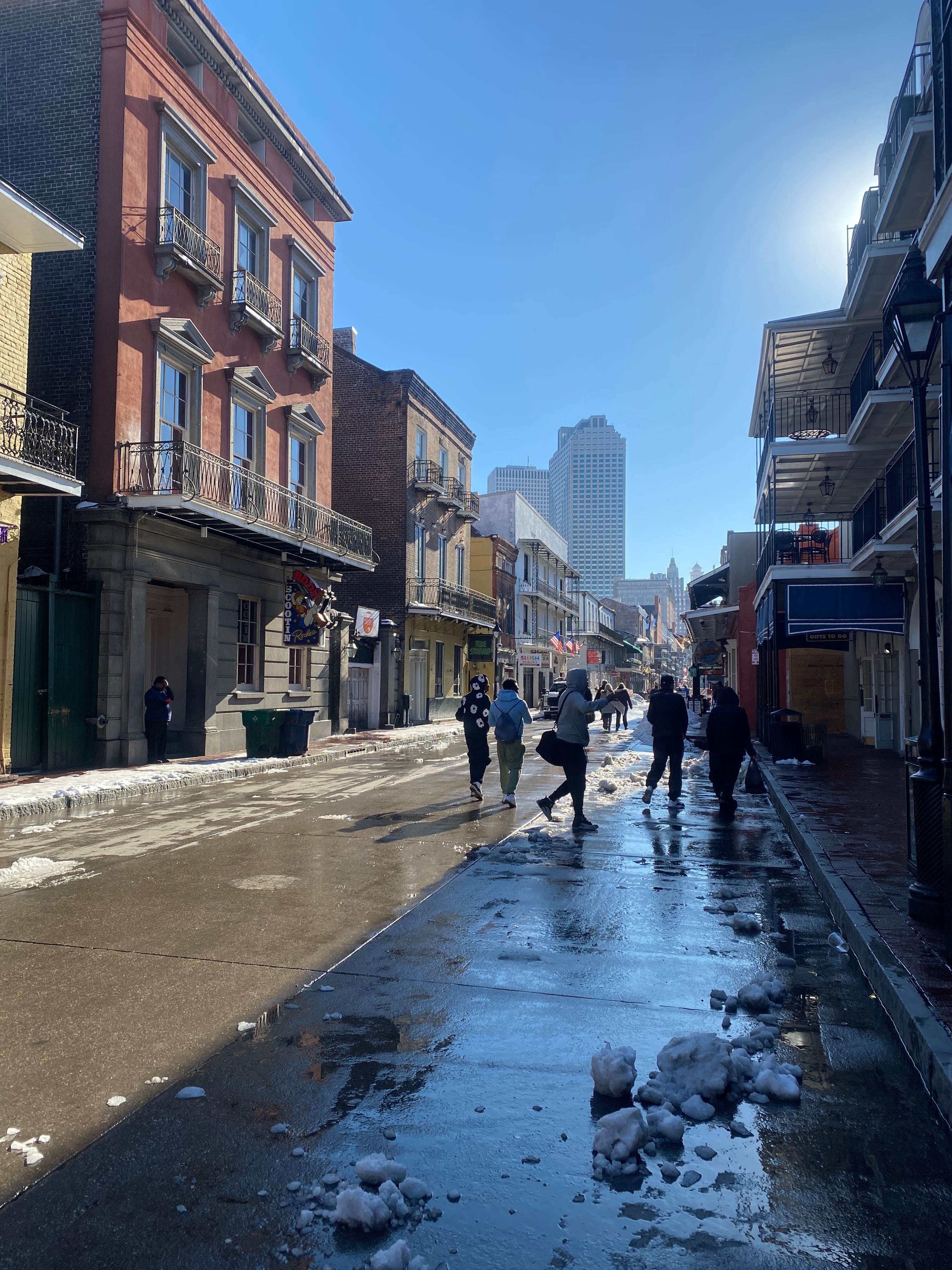
I finally left New Orleans on Friday morning, my Uber joining thousands of other cars heading to the airport on gridlocked surface streets—the highway was still closed due to icy conditions. As my plane took off, I looked down and could see small lingering patches of snow, the sun shining on them brightly. I had no doubt the sunlight would melt the snow in short course, soon erasing the last physical remnants of the historic “sneaux” storm that paralyzed the city for days.

Thanks for joining me this week.
Recommendations
China Stories
Abduweli Ayup, translated and with an introduction by Avi Ackermann, “A Thornbush in the Desert”
Noah Berman, “Who’s Who on Trump’s China Team”
ChinaFile Conversation, “Behind the Exodus of U.S. Law Firms from China”
Helen Davidson, “China’s economic need and soft diplomacy spur about-face on visa-free entry”
Aaron Glasserman, “Learning the Wrong Lessons at Harvard”
Jane Hu, “The Long Shadow of the Chinese Exclusion Act”
Many Chinese still remember Zhou (Enlai) as the original “good Premier.” They credit him with shielding thousands of victims from persecution, or worse, during the Cultural Revolution, when ultra-leftist extremists held sway. Half a century after he died, beatific imagery of Zhou is still hard to escape. Tour guides at palaces and museums explain that he protected cultural relics from destruction by rampaging Red Guards. In sprawling flea-markets, his iconography is almost as omnipresent as Mao’s. Yet middle-class Chinese admit they’re ambivalent. “Zhou’s reputation has been tarnished in recent years, especially among intellectuals,” one Chinese member of the intelligentsia told me. “I confess that I cried when Zhou died. He was the one who had given us hope.”
— Melinda Liu, “The Curse of the ‘Good Premier’”
Samantha Pearson, “Cattle Gallstones, Worth Twice as Much as Gold, Drive a Global Smuggling Frenzy”
Yaqiu Wang, “Can the U.S. Find a Balance between Scientific Openness and Security?”
Lingling Wei, “Americans Who Want to Do Business in China Need to Meet This Man”
To help his bureaucrats rediscover their mojo and revive a stagnating economy, Xi is also promoting the message that some mistakes are acceptable. His decree to the Communist Party: Enforcing strict discipline shouldn’t fuel a climate of fear that saps the can-do spirit that once helped power China’s economic rise.
— Chun Han Wong, “Xi Tells Officials Scared of Being Purged: It’s OK to Make Mistakes”
Chun Han Wong, “A Xi Enforcer Is Revving Up China’s Spy Machine—and Alarming the West”
Edward Wong, “Biden Made a Global Push to Constrain China. What Will Trump Do?”
Wanderings Around the World
Fara Dabhoiwala, “A Man of Parts and Learning”
Abdi Latif Dahir, “In African Publishing, ‘There Is a Renaissance Going On’”
It’s easy to forget that, even during war and reconstruction, artists keep making art. And that postwar life is about more than staying sheltered and fed. Han’s photographs reflect a sharp, inexorable striving—not only for safety but also for romance, learning, exploration, and aesthetic pleasure.
— E. Tammy Kim, “The Henri Cartier-Bresson of South Korea”
Richard C. Paddock and Muktita Suhartono, “Thailand Celebrates New Same-Sex Marriage Law With Mass Wedding”
Standout Stories
This week’s theme is Extraction.
Indonesian Borneo has long been known for its gold mineral wealth—and its gold rushes. As Nancy Peluso has previously explored at New Mandala, not all of this gold mining occurs through large corporations or formal enterprises. In Central Kalimantan province, unlicensed and informal small-scale gold mining (in Indonesian, Pertambangan Emas Skala Kecil, or PESK) supports the livelihoods of thousands of artisanal and small-scale (ASM) miners and their families, while also creating transformative environmental impacts.
—Keith Barney, Rini Astuti, and Yayan Indriatmoko, “‘It’s like Texas’: variations on informal gold mining in Central Kalimantan”
It has been exceedingly difficult for a great number of Serbs – not to mention Ghanaians, Bolivians, Portuguese, or any other nation dubiously blessed with significant lithium deposits – to reconcile corporate rhetoric about the substance’s central role in the great global green transition to come, and the rather more immediate, localised environmental destruction its cultivation will cause. I was often told by the activists and experts I spoke with in Serbia and beyond that there is simply no such thing as sustainable mining. “It is an oxymoron,” said Filipović. “Lithium by itself is not green, it cannot be because of the chemicals you have to use [to] extract it [and] the amount of water you have to use in that process”. The Jadar project is projected to have a 40-year lifespan. If that is how long Rio Tinto considers it to be a profitable venture, then what happens after, with the earth and surrounding land scarred beyond recognition, and with little hope of a return to agriculture?
— Francisco Garcia, “The Battle for the Soul of Serbia”
The mines around Morombo are part of a vast new frontier for Indonesia’s extractives industry. Nickel has become an obsession of the government in Jakarta, which has declared the mineral to be the foundation of a whole new economy for Indonesia. The mineral is an important component of stainless steel, but also of the batteries used in energy storage and electric vehicles (EVs). That makes Indonesia’s nickel reserves — the largest in the world — a resource of global significance, an opportunity for the country to position itself astride the international green transition.
— Peter Guest, “Dust Money”
Featured photo: Snow falling at the intersection of Carondelet and Common Streets, New Orleans, Louisiana, January 21, 2025.
 Maura Elizabeth Cunningham
Leave a comment