Books published in 2020 often didn’t get the attention they deserved. Kept at home by Covid-19 restrictions, authors weren’t able to tour and promote their new books in person; instead, they tried their best to reach readers through Zoom, podcasts, and social media. Unfortunately, a lot of wonderful and important titles fell through the cracks.
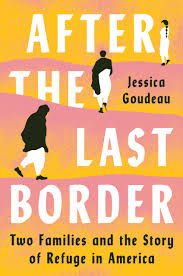
After the Last Border: Two Families and the Story of Refuge in America might be my personal number-one example of a book I’m sorry I missed when it was first published in August 2020. This account by Jessica Goudeau of two women—Mu Naw from Myanmar and Hasna from Syria—who have entered the United States through the Federal Refugee Resettlement Program (FRRP) is urgent, absorbing, and an absolute must-read.
Goudeau describes herself as a “writer and activist,” and After the Last Border balances the narratives of Mu Naw’s and Hasna’s lives with a subtle but compelling call to action. Short interstitial chapters provide an enlightening overview of U.S. policies toward refugees from the 19th century through 2019.
There has long been American ambivalence toward immigration; despite the country’s self-depiction as a melting pot that welcomed migrants from all over, the 19th and 20th centuries are littered with examples of exclusion, quotas, and racism toward outsiders. After World War II, however, the public felt shame over its failure to offer a safe harbor to Jews fleeing Nazi rule in Europe. Refugee policies became more accommodating. Lawmakers tangled over specific numbers of people who should be admitted, and some groups gained entry more readily than others, but there was a general understanding that people who fled dangerous circumstances and sought refuge in the United States should be given the chance to live a life of freedom and safety. By the time Jimmy Carter established the FRRP by signing the Refugee Act of 1980, Goudeau writes, refugee policy had bipartisan support that’s simply unimaginable today:
It feels stunning that there was a time when a program like this was built, when it easily earned support from people on both sides of the political aisle, when it moved beyond state and mosque or synagogue or church. When the word “refugee” invoked compassion and admiration and a strong desire to help. When politicians standardized the process, and the vagaries of public opinion made the numbers ebb and flow to a certain extent, but refugee admissions continued no matter what happened in our fierce national debates about American identity.
Those days have passed, though the change in attitude is a relatively recent one. Goudeau dates it to about 2015, when an influx of refugees from Syria collided with a renewed concern about terrorism and the rise of Donald Trump on the political scene. From the perspective of Trump and his MAGA acolytes, refugees are people getting one over on the U.S. government—scammers, or even criminals, who exploit a weakness in the system to gain entry to the country, where they take jobs and resources from Americans and pose a threat to public safety. Those who oppose refugee entry pay no attention to the intensive, invasive vetting process that applicants endure, and they ignore the fact that new arrivals often struggle to find and keep low-paying unskilled jobs. Nor do they show any concern for or sympathy about the traumatic and life-threatening situations that refugees have fled—the very reason they qualify for the FRRP in the first place.
Goudeau lays out the obstacles that refugees face at every step of the FRRP process through sharing the experiences of Mu Naw and Hasna. Mu Naw lost her home at the age of five: a member of Myanmar’s Karen minority, she and her family fled the country when her aunt resisted an army general who attempted to coerce her into sex. They crossed into Thailand and set up life in one of the many refugee camps established around the region for those escaping violence and oppression in Myanmar, but the move wasn’t a permanent one for Mu Naw. Her mother left her father, and soon Mu Naw was back in Myanmar being shuttled from one cruel relative to another until she finally heard that her mother had settled at another refugee camp over the Thai border. Mu Naw, barely a teenager, set off to find her.
Once she reunited with her mother at the Mae La camp, Mu Naw could have easily spent the remainder of her life there. Refugee camps are, in theory, only supposed to be temporary way stations en route to a new life elsewhere; in reality, most have become places where families live for decades. By her mid-teens, however, Mu Naw had realized that there was no future in a Thai refugee camp, forever caught in limbo. Newly married to Saw Ku, a high-school classmate, she put them forward for resettlement when the United Nations began offering Mae La residents the possibility of a home elsewhere. In 2007, Mu Naw, Saw Ku, and their two young daughters boarded a series of flights that delivered them to a new home in Austin, Texas.
Mu Naw cried daily as the family struggled to establish their new life in Austin. A refugee services agency provided assistance, but its small staff and limited funding couldn’t offer everything Mu Naw needed. Nor could it help with the emotional toll of resettlement. She proved more adept than Saw Ku at learning English and figuring out how to navigate the American system; his struggles to adjust led to friction between the two. The situation grew more complicated when, not long after their arrival, Mu Naw realized she was pregnant. The birth of their son was a brief spot of joy in a relationship that had entered a downward spiral. As she and Saw Ku grew further and further apart, Mu Naw began to contemplate divorce—a marriage, it seemed, sacrificed to the strain of refugee life.
Slowly, though, Mu Naw and Saw Ku managed to claw their way to stability, piecing together low-paying jobs and assistance from their church to establish both a financial foothold and a renewed bond between the two. First came a car, then a house—tangible symbols of a permanence Mu Naw had never known:
Almost a decade has passed since they arrived in Austin, and her children don’t even think in terms of safety and freedom anymore. Those things are such a part of their lives, they rarely feel grateful for them. But their parents never forget, never take their joy for granted.
When readers leave Mu Naw in January 2016, her life is secure and peaceful. There will still be struggles, for sure, and she will forever be split from her family and her original home. But she shows no regret about taking up the UN offer of resettlement and moving to Texas. The difficulty, the pain, the years of scraping by—for Mu Naw, it has all been worth it.
Thousands of people left Syria in the early 1980s, fleeing the brutal and repressive regime of Hafez al-Assad. Hasna al-Salam was not one of them. She and her husband, Jabreel, remained in the southern city of Daraa, even after international sanctions against Syria prevented Hasna from obtaining the medication that would save the life of her third son, who died as a baby of untreated asthma and malnutrition. This tragedy would forever haunt Hasna. In time, however, those years of upheaval passed. When we meet Hasna, now a grandmother in her late forties, in March 2011, she has settled into a life characterized by routine, community, and stability:
Her children were only the latest generation to grow up in this house, where dozens of al-Salam children had been raised over the decades. The houses in the streets surrounding the small al-Salam Square, which was what everyone called the small plaza around which their clan life revolved, changed with every generation. Each family added balconies and second-floor apartments, took out some walls and added others in a complicated hodgepodge that defied any sort of architectural order. The result was a labyrinthine neighborhood where the houses were joined in an elaborate system of connected garden walls and alleyway shortcuts that the children innately understood and that was all but incomprehensible to outsiders.
Hasna and Jabreel had studiously avoided politics, learning early on that “political engagement in Syria under Hafez al-Assad was a high-risk game they’d rather not play.” Yet they could not remain detached when protests began on the evening of March 18, 2011, young men rising up to speak out against the rule of Bashar al-Assad, who had succeeded his father as Syria’s leader. Although Assad had fought to keep the Arab Spring movement from gaining a foothold in his country, “There were too many young men with no opportunities, too much pent-up fury, too many whispered stories of toppled leaders and revolutions in neighboring countries.” A spark ignited; the government fought back. Protests grew into a civil war that only ended a few weeks ago—nearly fourteen years of unending conflict tearing apart the country.
Even as rebels and Assad fought for control of Syria, however, Hasna and Jebreel never entertained the thought of leaving their home. They adapted to the steady encroachment of new struggles in their daily lives: unexpected blackouts, empty shop shelves, soldiers carrying out searches of their home. Only when it became clear that their children and their families were no longer safe, and that their youngest daughter, Rana, could not continue her high-school education, did the couple contemplate departure. Even then, their move was piecemeal. Hasna brought Rana across the porous border with Jordan, where her other children and their spouses had secured apartments and day-laborer jobs. Hasna traveled back and forth for more than a year, always viewing her family’s relocation as a temporary one despite the increasingly dire conditions in Syria. Even when she finally packed to leave—Jebreel would remain in Daraa to protect their house—Hasna brought only a few weeks’ worth of clothing. She remained convinced that the al-Salams would one day reunite in the home that had sheltered generations of their family members.
That house is gone, destroyed in a missile attack that also seriously injured Jebreel in October 2013. A relative in Daraa managed to find an ambulance that took him into Jordan for extensive reconstructive surgery. By then, Hasna had begun to accept that the separation from her homeland would not be a temporary one. Step by step, she undertook the administrative moves that mark the lives of 21st-century refugees, first officially registering her presence in Jordan, then accepting an out-of-the-blue offer from a United Nations staff member to put her on the waiting list for resettlement:
She almost turned him down. Resettlement was of no use at all if peace in Syria was right around the corner. But he suggested that she at least come to the office and hear more—she did not have to take resettlement if she didn’t want to, but why not at least keep her options open? The process took at least two years; many things could change in that time. She agreed to come, but in a way that made it clear that she was humoring him.
Peace in Syria, of course, was not right around the corner. Hasna went to that first meeting, then another, then eventually—suddenly—found herself boarding a plane bound for the United States. (Resettlement is a process that happens gradually, then all at once; years of paperwork and interviews culminate in the news that refugees have only days to gather their lives and prepare for departure.) In August 2016, Hasna, Jebreel, and Rana arrived in Austin. Her other children were in Jordan and Turkey, hopeful that one day the FRRP’s guiding principle of family reunification would permit them to join their parents in the United States.
Hasna had not, however, anticipated the election of Donald Trump as U.S. president only months after her arrival in Texas. The travel ban that Trump imposed in late January 2017 prohibited citizens of several Muslim-majority countries from entering the United States. The ban also indefinitely suspended the resettlement of Syrian refugees—including Amal, Hasna’s eldest daughter, and her family, who were in the final stages of the FRRP administrative process. Instead of being the first to join her parents in Texas, Amal found herself resettled in Quebec. Still struggling to adjust in Austin, Hasna was unprepared for the possibility that her family would remain permanently separated. The years of their close-knit multi-generational life in that Daraa house retreated further and further into the past.
Hasna’s story ends on a less hopeful and more ambiguous note than Mu Naw’s. She is uncertain when, or if, the al-Salams will ever manage to reunite. All Hasna can do is pray:
She begged Allah to keep his hands on her loved ones all around the world. Hasna’s hope diminished to one thin thread: If they could not be together, inshallah, that they would at least be safe.
The Federal Refugee Resettlement Program did rebound in the years since Goudeau published After the Last Border, though of course the Covid-19 pandemic prevented most entries in 2020 and 2021. As we enter a second Trump administration, though, the number of those who are offered sanctuary in the United States will surely once again drop. And as Goudeau shows, just gaining placement in the U.S. is not a golden ticket: Mu Naw and Hasna both faced incredible challenges in resettlement, from figuring out bus schedules and obtaining medical insurance to finding steady work and resolving new tensions in their marriages. The resources available to them were nowhere close to what they needed.
“My relationships with Mu Naw and later with Hasna are the core of this narrative,” Goudeau writes. “If they are displeased with how this book is written, if I have done a disservice to their lived experiences, then I have failed.” I don’t know what Mu Naw and Hasna think of After the Last Border. I don’t know how their lives have unfolded since the book’s final page. What I do know is that Goudeau’s account of their stories and U.S. refugee policy—its ideals, its successes, its failures—is one that every person in this country should read. Perhaps if they did, fewer people would be so quick to slam the door on those most in need of an open entryway.
 Maura Elizabeth Cunningham
Leave a comment