
December! Well, Decem-brrrr here in Michigan … it was 19 degrees outside and snowing lightly when I woke up this morning.
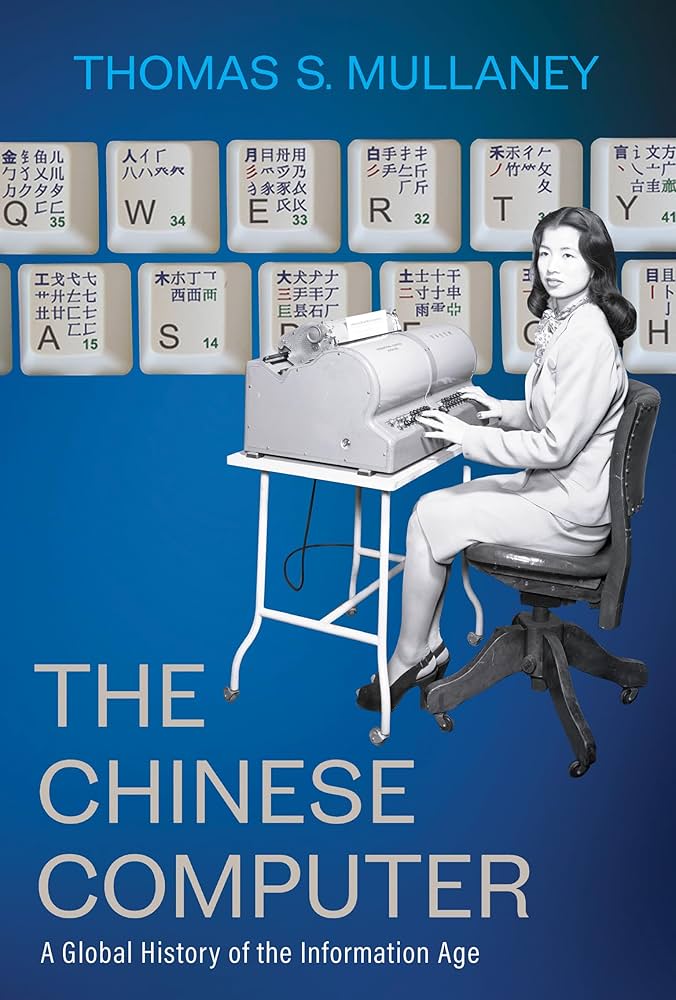
In addition to the links below, I have a new piece just up at the Los Angeles Review of Books:
The creation of character input methods, and how thinking about them has changed our relationship with language itself, is the core subject of The Chinese Computer: A Global History of the Information Age, by Stanford University history professor Thomas S. Mullaney. In this new sequel to his 2017 book The Chinese Typewriter: A History, Mullaney covers the story of Chinese computing from the late 1940s through the present day, describing experiments in hardware and software that failed more often than they succeeded but have nevertheless left behind enduring legacies for the entire computing world. These technological palimpsests break through every time Microsoft Outlook attempts to complete a sentence for me, or whenever Google suggests the end of a search term while I’m still typing.
Thanks for joining me this week.
Recent Goodreads Reviews


I learned of Baldwin’s book from this Drafting the Past podcast interview with him, which I recommend as good companion listening for insight into his approach to writing.
Recommendations
China Stories
Laura Bicker, “China’s giant sinkholes are a tourist hit – but ancient forests inside are at risk”
Michael Birnbaum and Cate Cadell, “Three Americans wrongfully detained in China released in prisoner swap”
The marathon prosecution, which began three years and eight months ago, ended quickly on Tuesday. In a tense overflow room packed with family, friends, press and lawyers, the dispassionate voice of judge Andrew Chan alternated over the speakers with the more abrasive crackle of a Chinese interpreter. The jail terms were announced so quickly that many of the defendants’ friends and family turned to each other to confirm what they had heard. The hearing, which some members of the public had lined up for days to attend, was over in less than ten minutes.
— Eliot Chen and Rachel Cheung, “Hong Kong’s Democracy Movement Receives Its Sentence”
Katrina Northrop and Christian Shepherd, “Chinese journalist and former Harvard fellow sentenced to 7 years”
Dalia Parete, Ryan Ho Kilpatrick, and David L. Bandurski, “Media in Focus: ‘Iron Brothers’ for the China Story”
We see a lot of change starting in the early 1970s. Starting is an important concept here, because these are seeds being sown that only come fully into fruition quite a bit later on. There are experiments, rebellions, acts of disobedience. There are losses of faith in the way things are and the start of something new. We time that change as being in the very early 1970s. That’s one of the aspects of this book that is probably going to be picked up on by people who are working within this field: We see so much of this starting to happen on the ground, well before the changes from the top start happening in the 1976-78 period.
— Andrew Peaple, “Odd Arne Westad on the Decade that Shaped China’s Modern Destiny”
**My review of The Great Transformation: China’s Road From Revolution to Reform, by Odd Arne Westad and Chen Jian, at the Wall Street Journal**
Christian Shepherd and Katrina Northrop, “China announces top military official is under investigation”
Alexandra Stevenson, “Once China’s ‘Worst Nightmare,’ Labor Activist Refuses to Back Down”
Li Yuan, “China’s Police Are Preying on Small Firms in Search of Cash”
Wanderings Around the World
Severia Bel and Hyerim Jang, “The Gendered Battle Over Digital Sexual Abuse in South Korea”
Despite being the first public crematorium in the United States, there is an undeniable air of mystery surrounding the Lancaster Crematorium. Besides a short Wikipedia page containing the most basic of information and a bite-size article from Atlas Obscura, the trail to understanding Lancaster Crematorium’s enigmatic history is found in paper and ink from bygone centuries: newspaper archives.
— Bodie Cambert, “All Is Perfect Quiet”
Julia Jacobs, “After Five Generations, a Family Gave Back the Treasures in its Closet”
Many of the good friends I have at age 35 are people I met in exercise classes I attended regularly. These experiences have convinced me that group fitness classes are the best place to make friends as an adult—an idea supported by research that suggests that the glow of exercise’s feel-good chemicals has interpersonal benefits.
— Mikala Jamison, “A Ridiculous, Perfect Way to Make Friends”
Mujib Mashal and Hari Kumar, with photographs and video by Atul Loke, “These Exams Mean Everything in India. Thieves See a Gold Mine.”
Dalia Parete, “The Push and Pull of Press Freedom in the Philippines” and “Keeping an Eye on Myanmar”
Hailey Salvian, “The PWHL pulled off its inaugural season. Year 2 will decide the future of women’s pro hockey”
Rachel L. Swarns, “Scholars Thought White Women Were Passive Enslavers. They Were Wrong.”
Standout Stories
“America imprisoned their own Americans only because of their race, but the irony is that they didn’t take away baseball,” said Kerry Yo Nakagawa, an author and a historian of Japanese American baseball. “And instead of rejecting it, being bitter, because they took everything else away — Japanese Americans couldn’t speak their native language, many of the faiths you couldn’t practice in the camps initially — baseball was the one thing they gravitated to and embraced.”
— Tim Arango, with photographs by Hana Asano and video by Scotty Uyeda, “In an Internment Camp, All They Had Was Baseball. A New Generation Is Back to Play.”
Longyearbyen, home to about 2,500 inhabitants, is located halfway between mainland Norway and the North Pole. It straddles the same latitudinal lines as the top of Greenland in an Arctic region that has become a geopolitical and economic hot spot, as relations grow frostier between the West and Russia and polar ice caps melt due to the worsening climate crisis. When something strange happens here, it is usually a consequence of something important unfolding elsewhere. An unusual legal framework means foreign people can live in the region and foreign entities can gain a foothold there. The Norwegian administration, which once welcomed the foreigners, now feels the city’s destiny is slipping out of its hands. A conflict is raging between what the community has turned into and what those who administer it expect.
— Sofia Cherici and Federico Ambrosini, “The Norwegian Archipelago That Became an Unexpected Melting Pot”
Daniel Wanschura, “A New Hope for Anishinaabemowin” — podcast episode about the First Nations woman who voiced Princess Leia in a new dubbing of Star Wars
Featured photo: People milling about on Liberty Street shortly before the start of the Ann Arbor Turkey Trot, November 28, 2024.
 Maura Elizabeth Cunningham
Leave a comment