
In late 2011, Elizabeth Pisani set off on a yearlong trip throughout Indonesia. This was no Eat, Pray, Love-style journey: Pisani wasn’t going to the archipelago in search of herself. Instead, she was looking for Indonesia.
Pisani, in many respects, already knew the country. She had been stationed in Jakarta as a journalist for Reuters between 1988 and 1991, then returned in 2001 after switching her field to public health, working on epidemiological projects for the Ministry of Health until leaving again in 2005. Annual visits from her home base in London maintained Pisani’s connections there, and over time she realized Indonesia was like her “Bad Boyfriend,” the country always drawing her back even when it frustrated her. And the thing about a Bad Boyfriend, Pisani understood, is that “however much you sometimes want to slap him, you always want other people to admire this wild and exotic beast, to wish they knew him better.” Indonesia, which loomed so large in her own life, received little attention from most people elsewhere.
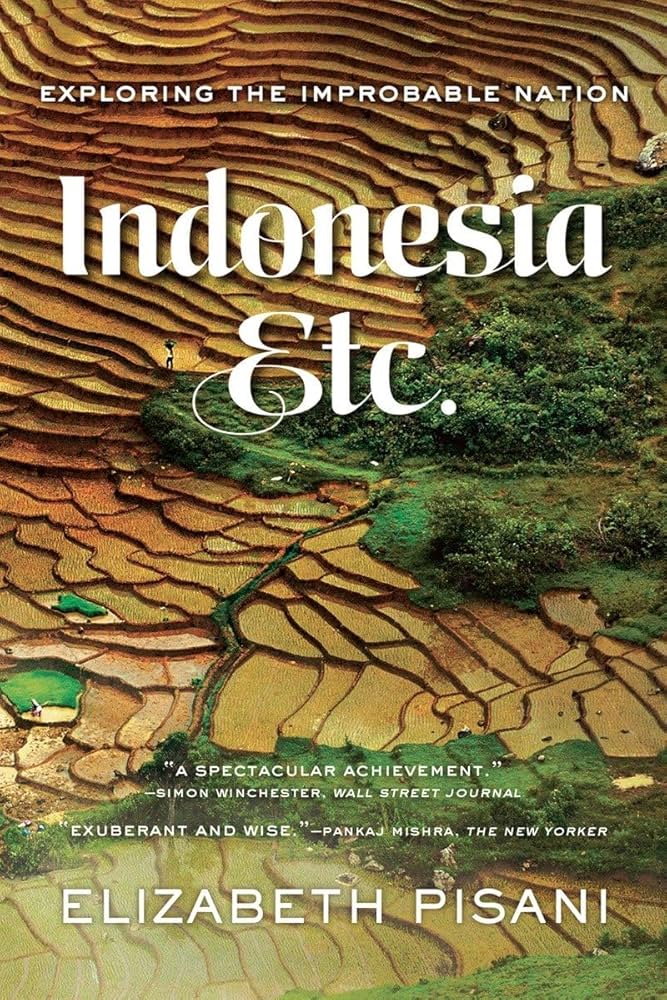
Pisani thus set off to travel Indonesia and write about her adventures, rationalizing that “A book about Indonesia would give me an excuse to spend more time in the country, to get to know it better, to try to understand how it has changed over the years of my sometimes frustrated devotion.” Over thirteen months, she moved from island to island, mostly eschewing larger cities in favor of tiny villages. Indonesia Etc., published in 2014, shares a wealth of stories and insights, Pisani’s friendly, unflappable nature coming through in her chatty and deeply informed prose.
Friendly and unflappable comes in handy when waiting for ferries that rarely arrive on schedule, getting invited to a funeral or wedding on short notice, and being pulled on stage to perform as the intermission entertainment during a puppet show. All of this—and so much more—happened to Pisani during her travels. She wanted her trip to unfold in such a manner. Rather than set off with a rigid itinerary, Pisani devised a loose route that she planned to follow but allowed plenty of room for improvisation, guided by the one rule she set for herself: “Just say yes.”
The “Etc.” of the book’s title refers to a phrase in the Proklamasi of August 17, 1945*:
We, the people of Indonesia, hereby declare the independence of Indonesia. Matters relating to the transfer of power, etc. will be executed carefully and as soon as possible.
“Etc.” skims over the challenges of governing a large but fragmented country—one broken up not just geographically into more than 17,000 islands, but also culturally, linguistically, religiously, and economically. Since achieving independence in 1949, Indonesia’s various leaders have attempted to find the right formula, swinging between the extremes of centralization and decentralization, often with little advance notice. Like her own trip, Pisani views governance of the archipelago as improvisational and subject to change at any given moment.
Friendly, fearless, and fluent in Bahasa Indonesia, Pisani worked to integrate herself into the community wherever she went. Sometimes that level of ease was facilitated by connections made during her previous travels—in some cases, even after the span of decades people remembered Pisani and welcomed her back into their homes. In other instances, Pisani made a space for herself simply by showing interest and asking questions about the lives and traditions of the people she met. More than anything else, she was able to slip into the fabric of small villages by refusing to keep herself apart: Pisani stepped in to help with farm work, cooking, frog hunting, and more. As a foreign woman, she was generally able to move between the usually separate male and female spheres. Having this dual perspective leads Pisani to a realization while observing protracted negotiations over the purchase price of sugar toward the end of the book:
Evi’s husband began another complicated game on his phone. The cousin-driver smoked. All the wheeling and dealing, the polite chit-chat and hard-edged ultimatums came from the mouths of women. It mirrored what I had found in more domestic situations elsewhere in Indonesia: the people in formal positions of power—the bupatis, the village heads, the religious leaders, the shamans—were all men. But it was usually the women who actually decided how many buffalo would be slaughtered, which rice fields would be sold off, which of the children would go to college.
A decade after the book’s publication, Indonesia remains comparatively overlooked on the world stage, and continues to negotiate the challenges of managing that “Etc.” in the Proklamasi. It remains, in the description of the book’s subtitle, “the improbable nation.” Indonesia Etc. is not—and cannot be—a comprehensive study of the archipelago’s people and places; in 13 months of travel, Pisani was still only able to scratch the surface of everything Indonesia has to offer. Instead, she has assembled a satisfying collage of experiences and anecdotes that presents readers with a vivid, memorable journey through some of the country’s least-visited areas.
*This text is the translation of the Proklamasi that Pisani uses, which differs in word choice but not in overall meaning from the one David Van Reybrouck employs in Revolusi. I have used the text favored by each author in my reviews of the two books.
Featured photo: Farmland in central Java, Indonesia, as seen from the train between Jakarta and Yogyakarta, July 8, 2024.
 Maura Elizabeth Cunningham
Leave a comment