Happy Sunday and happy fall—allegedly, as I am writing this with a fan trained on my face and a glass of ice water at hand. Despite the continuing summer temperatures, there are hints of the season’s impending change: a touch of red and gold on the trees, pumpkin spice everything in stores, the beginning of training camp for hockey players last week.
This is also the end of my own summer vacation, as tomorrow I’ll go back to work after a month off. No, I didn’t accomplish everything I had planned for that extended break. There are books unread, drawers un-sorted, walks un-taken. But I had a good month nonetheless, with some long writing sessions, a few Amazon Prime binges, travel, and the opportunity to catch up with several friends along the way.
I wouldn’t want such a long break every year, and my co-workers probably wouldn’t be pleased if I made it a regular thing. I don’t know when I’ll have another chance, though, so I’m glad that I was able to take this one. And now, with the start of a new season, I’m ready to bring this sabbatical to a close and get back to whatever passes for “normal” these days.
Thanks for joining me this week.
Recommendations
China Stories
Kelly Kasulis Cho, “China frees U.S. pastor after nearly two decades, State Department says”
China’s digital surveillance and censorship efforts have reached their full potential in Tibet. Indeed, several experts say the autonomous region has emerged as a kind of success story, with the policies there serving as a model for other areas that Beijing wants control over, such as the Uyghur regions in Xinjiang.
— Nithin Coca, “Remember Tibet?”
Barbara Demick, “The End of Adoptions from China”
Ryan Ho Kilpatrick and Heng Yu Chien, “Televising Taiwan’s Painful Past”
Michael Laris, “China shut down foreign adoptions. This family doesn’t want to give up.”
Yufan Lu and Lyric Li, “China’s divorce rate soars. Cue the high-powered wedding photo shredder.”
David Pierson, “In New York Case, Signs of a Familiar China Playbook”
Krishna Pokharel, Austin Ramzy, and Tripti Lahiri, “A Frailer Dalai Lama Greets Devotees While Succession Question Remains”
Amy Qin and Vivian Wang, “An Era of Chinese Adoption Ends, and Families Are Torn Over Its Legacy”
Liyan Qi, with photographs by Jovelle Tamayo, “The Missing Girls: How China’s One-Child Policy Tore Families Apart”
Daniel Wu, “85 years later, Chinese family honors the Black couple who rented to them”
Wanderings Around the World
Lisa Abend, “Looking for a New Way to See Iceland? Bring Your Knitting Needles.”
Poised atop a column of Egyptian granite, the bronze “Lion of Venice” looks out on the sprawling Piazzetta San Marco. The massive statue has been a symbol of the Italian city since at least 1293 and is connected to the patron saint of Venice, Mark the Evangelist, often symbolized as a lion. However, a new study of the winged leonine artwork’s lead isotopes reveals that a major part of the statue is made of bronze from 8th-century China. Led by scholars from the University of Padua and the International Association of Mediterranean and Eastern Studies, the findings point to the global nature of trade during the Middle Ages and the impressive reach of arts from China’s Tang Dynasty (618–907 CE). It also underscores the increasing importance of isotopic analysis within art history.
— Sarah E. Bond, “Is the ‘Lion of Venice’ Actually from China?”
Hannah Ellis-Petersen and Redwan Ahmed, “‘A long way to go’: in revolution’s wake, questions linger over direction of the new Bangladesh”
Diaa Hadid, Fariba Akbari, and Khwaga Ghani, “Afghan women sing to protest a law that orders them to keep quiet”
Richard Luscombe, “Hot queen conch seeks cool mates: Florida’s new ‘speed dating’ service to save endangered shellfish”
Helen Sullivan, “Stamps, sticks and stories: looking for traces of baseball in North Korea”
Standout Story
I can only imagine what this spectacle looks like to the rest of the world. Meanwhile, the Haitians in Springfield are trying to live their lives. Years ago, Springfield was a dying town, with a declining population. As part of a revitalization effort, the town courted new businesses, and as manufacturers opened up their facilities, they needed employees. Haitians, often by word of mouth, shared with other Haitians that there was good work and a good life to be found in Springfield. This is how most immigrant communities in the United States form; there’s nothing conspiratorial about it. Springfield was a safe place where Haitians could go and raise their children, and even though it meant leaving the only place they had ever known, there was also the promise of some community—the simple pleasure of sometimes being in conversation with other people who share the same cultural vernacular. These Haitians wanted to find home, even if it meant having to wander far afield.
— Roxane Gay, “The Haitian Question”
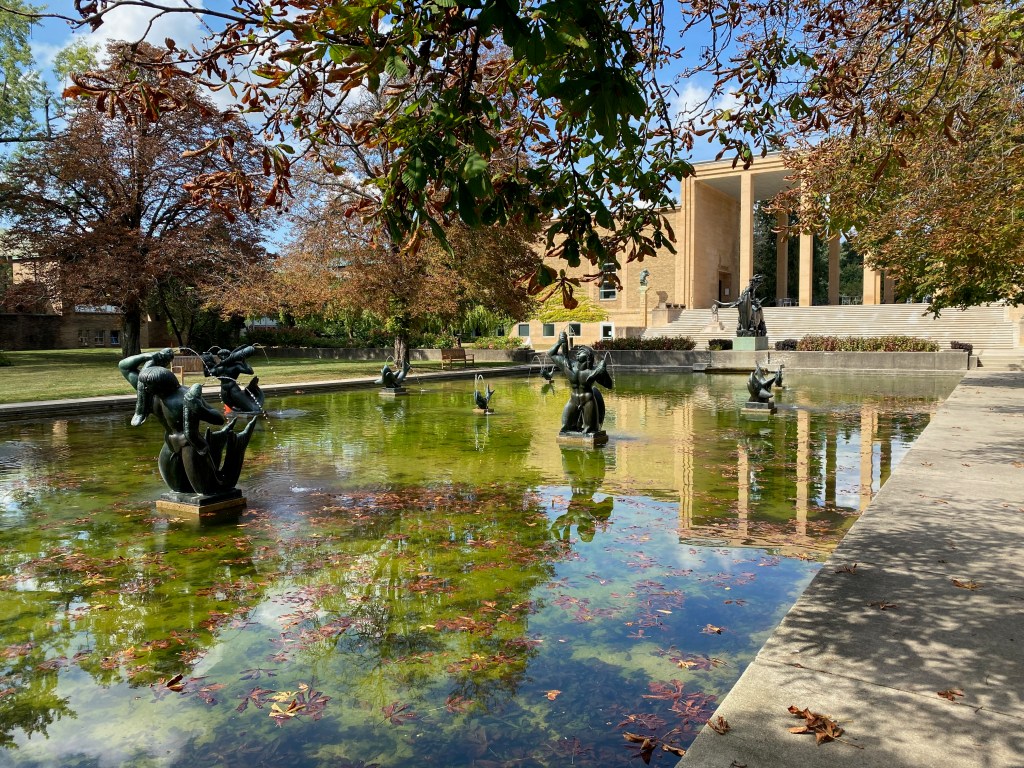
Featured photo: Cranbrook Art Museum, Bloomfield Hills, Michigan, September 19, 2024.
 Maura Elizabeth Cunningham
Leave a comment