How is it still January?? This month has felt an eternity long, and yet I’m still getting emails that start out “Happy New Year!” Time seems to be moving slowly in 2024.
Last week I wrote about “China’s Southern Paradise,” a special exhibition at the Cleveland Museum of Art that highlighted the artistic lineage of the Lower Yangzi Delta.
Recommendations
Follow-Up on the Taiwan Election
Bonnie S. Glaser, “Taiwan Opts for Continuity”
Lili Kuo, “After attempts to meddle in Taiwan’s elections fail, China takes stock”
In a world gone mad, Taiwan’s story is indisputably, heartbreakingly hopeful. According to the nonprofit Freedom House, Taiwan is the sixth most free country in the world – above France and the US. It has legalised same-sex marriage, making it a haven for queer people across Asia. It boasts one of the highest rates of female participation in the legislature. It has universal healthcare and affordable public transport. The DPP holds on to a vision of Taiwan that is genuinely multicultural and multilingual. This is a giant thorn in Beijing’s side, because Taiwan shows that democracy works.
Michelle Kuo, “Taiwan’s election result is a triumph for democracy – and a thorn in Beijing’s side”
Albert Wu, “A teary-eyed post-election missive”
Taijing Wu and Ken Moritsugu, “Nauru switches diplomatic recognition from Taiwan to China”
Li Yuan, “Taiwan’s Democracy Draws Envy and Tears for Visiting Chinese”
China Stories
Track-two sessions can provide intelligence on what the other side is thinking and suggest policy proposals but they can’t substitute for government action. Still, the fact that these kinds of talks are picking up after years of deteriorating relations between Washington and Beijing suggests efforts in both capitals to stabilize the world’s most important bilateral relationship.
Bob Davis, “Back on Track?”
Jonathan S. Landreth, “Vanessa Hope on Taiwan, the Invisible Nation”
Within the LGBTQ+ community, trans and non-conforming people are the most vulnerable. China sets stringent criteria for accessing gender affirming surgery (you must be aged 18 or over, unmarried, have parental consent and a clean criminal record), which is required to legally change your gender.
Jessie Lau, “‘It’s difficult to survive’: China’s LGBTQ+ advocates face jail and forced confession”
Warren P. Strobel, “Chinese Lab Mapped Deadly Coronavirus Two Weeks Before Beijing Told the World, Documents Show”
Ruslan Yusupov, “Sinicising Islam in China: The Story of a Mosque”
Wanderings Around the World
Keisha N. Blain, “What Jonathan Majors got wrong about Coretta Scott King’s legacy”
Johannes Lichtman, “Invisible Ink: At the CIA’s Creative Writing Group”
Anne Helen Petersen, “True West: Disassembling myths and the dinosaur museums that sustain them” — interview with Betsy Gaines Quammen, author of True West: Myth and Mending on the Far Side of America
Motoko Rich, “A Woman Who Shows Age Is No Barrier to Talk Show Stardom”
As we experience unprecedented (in scale, not kind) attacks on historical research and teaching, it struck me as particularly important to open a more general conversation about the contexts and costs of the invisibility of humanities research. I am particularly concerned with the implications of leaving the vast infrastructure of research invisible to a public largely unaware or unconcerned with how much hard-won knowledge, including creative endeavor, that research has facilitated.
Karin Wulf, ““Mrs. Foster Has Sworn A Rape”; or, What Do We Owe? Generosity, Attribution, and the Perilous Invisibility of Research Infrastructure”
Sameer Yasir, with photographs by Elke Scholiers, “‘A Lifelong Nightmare’: Seeking Justice in India’s Overwhelmed Courts”
Standout Story
At the border, Sabit could see the Kazakh steppe: wind-strewn grass among patches of snow. Behind it was a mountain range, wild and pristine. Everyone disembarked into a Chinese border station, where each passenger was called for an interview, until Sabit was waiting alone. Finally, in a windowless chamber, three officials, one with a camera mounted on his shoulder, interrogated her for forty minutes. Then they told her that she, too, could go. Crossing into Kazakh territory, she felt a wave of relief. She thought of the border guards as family. People were speaking Kazakh freely. With barely any possessions, she sailed through customs. A cousin was there to pick her up and return her to her mother. A strong wind blew as she walked to his car, and she took in the crisp air. After a year and eight months as a captive, she was free.
Raffi Khatchadourian, “Surviving the Crackdown in Xinjiang”
This New Yorker article is nearly three years old, but, sadly, the Chinese government’s repressive actions against the Uyghur community continue to play out today. If you’re interested in more explanation of what has happened in Xinjiang but aren’t yet ready to take on a book-length treatment of the events there, Raffi Khatchadourian’s piece is the place to begin.
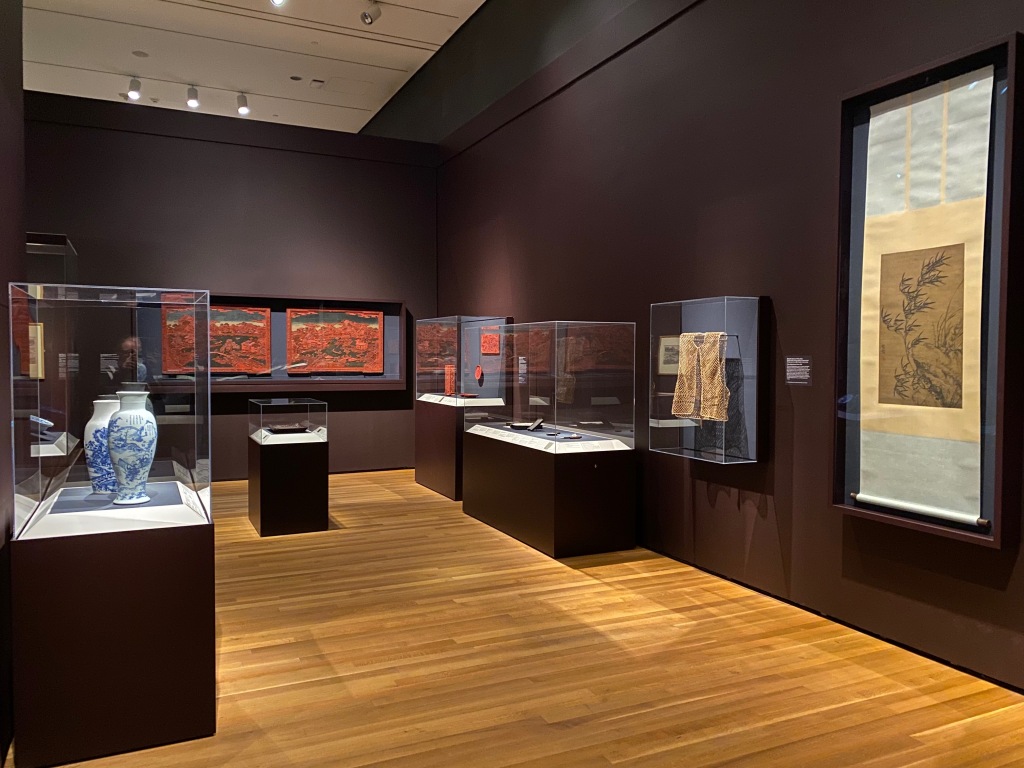
Feature Photo: “China’s Southern Paradise” exhibit, Cleveland Museum of Art, November 15, 2023.
 Maura Elizabeth Cunningham
Leave a comment