
On Monday night I was scrolling through Bluesky when a post from Jeremy Goldkorn caught my eye:
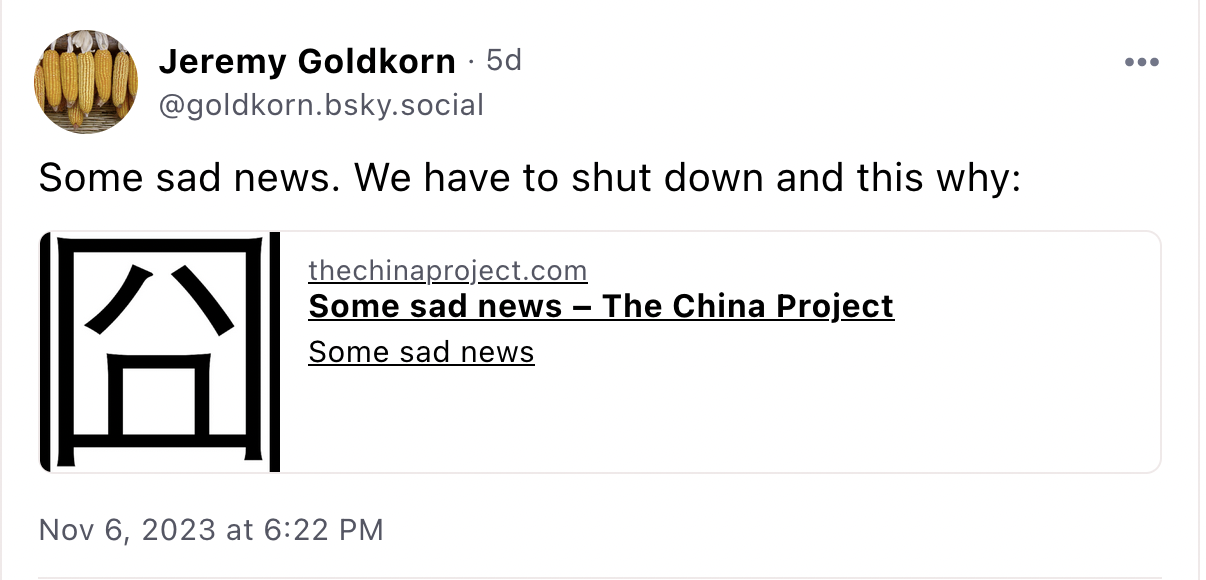
The China Project (founded in 2016 as SupChina), a leading digital magazine and media organization in the China world, would be closing up shop—effective, it seemed, more or less immediately. An announcement at the site explained that a combination of low advertising revenues, the loss of important outside funding, and expensive legal fees (the site has been accused in both the U.S. and China “of working for nefarious purposes for the government of the other”) left The China Project without a firm financial footing. Rather than run the company into the ground before exhausting its savings, Goldkorn and others in leadership decided to shut it down as soon as possible.
Seven years is an impressive lifespan for a media company in this landscape, but the sudden closure of The China Project is still a disappointment. The site was wide-ranging, offering something for everyone—I usually skipped its stories on semiconductors and electric vehicles, but always clicked on Xinjiang columns by Darren Byler and the latest episode of the Sinica Podcast. If you’ve been following my weekly reading recommendations here, you’ll notice that one or two of the China Stories are usually publications from The China Project, and plenty of others came to me via its weekday emails aggregating news of the previous 24 hours.
Sooner or later, it seems, the day of destiny comes for all online media endeavors, especially those with a comparatively niche audience. The China Project faced difficulties specific to its own circumstances, but the broader story of inadequate funding and increasing expenses holds true all across the publishing sphere.
Thanks so much, and best of luck, to all who worked to make The China Project the valuable resource it was over the past seven years.
This week also saw the closure of Jezebel, a feminist pop-culture site that I read in grad school whenever I needed a break from the mountain of coursework I was supposed to be doing. I’ve drifted away from Jezebel in years since; the celebrities they named grew less familiar to me, and the sheer volume of posts they published made it difficult to keep up. The Jezebel closure appears far more cold-blooded than that of The China Project: G/O Media, the holding company that owns Jezebel and other publications, claims it wanted to sell the site but couldn’t find a buyer. As Danielle Cohen details at The Cut, there have also been ongoing battles between Jezebel’s staff and G/O over issues like use of AI in producing content and the emphasis on metrics rather than quality. “Jezebel’s slow death over the past few years,” Moira Donegan writes at the Guardian, “was exacerbated by the injection of private equity into the media industry, a medicine that has turned out to be worse than the disease.”
I disagree with Donegan, however, when she goes on to argue that Jezebel’s closure also marks the end of the feminist movement it and many other blogs were born from in the late 2000s/early 2010s. Rather, the movement has—well, moved. The successors to Jezebel and Feministing and Bitch are not new websites; they’re podcasts and Substacks and posts on TikTok and Instagram. We now see a much more fragmented media landscape, but it’s also a much bigger one—thanks to the influence of Jezebel and other sites.
I am deep into a fiction binge right now, as my recent Goodreads reviews reflect:


Recommendations
China Stories
Alexander Boyd, “Interview: Jewher Ilham on the Documentary ‘All Static and Noise’”
Eliot Chen, “Shibani Mahtani & Tim McLaughlin on the Evolution of Hong Kong’s Identity”
Wenxin Fan, “A City’s Rock ’n’ Roll Fantasy Meets Die-Hard Bureaucrats”
Fan Yiying and Liu Shuhuan, “The Bookstore Giving Shanghai’s Women a Room of Their Own”
Brian Spegele, “China Has an Idea for Its Legions of Unemployed Youth: Send Them Away”
William Wan, “The hidden power of China’s pandas — and why the U.S. is losing them all”
Wanderings Around the World
As his parents told him in the aftermath of his lone NHL game, he had made it. Of all the kids around the world who grow up playing hockey, only a fraction of a fraction of a fraction play in the NHL. Koehler was one of them. He reached the pinnacle, even if only for mere seconds.
Peter Baugh, “The shortest career in NHL history? 1 shift. 4 seconds. 0 regrets”
Max Colchester, “How an Academic Uncovered One of the Biggest Museum Heists of All Time”
Ruby Cramer, “The Librarian Who Couldn’t Take It Anymore”
Tamar Jacoby, “Not So Quiet on Ukraine’s Southern Front”
Karishma Mehrotra and Joseph Menn, “How India tamed Twitter and set a global standard for online censorship”
In his crisply written and incisive new book, “Gun Country: Gun Capitalism, Culture, and Control in Cold War America,” historian Andrew C. McKevitt chronicles the transformation of guns from tangible weapons to ideological ammunition. Sharp, fascinating, devastating, exhaustively researched and often wryly funny, this indispensable book — one of the best works of nonfiction this year — details how America came to be not just a gun country but the gun country, home to “nearly half of all civilian-owned firearms in the world” and “more than twice as many guns per person” as any other nation. It begins with a crucial yet neglected premise: Guns are not abstractions but products.
Becca Rothfeld, “The real origins of America’s gun culture” — huge congratulations to fellow Saint Joseph’s University alum and historian Drew McKevitt for this rave review of his new book at the Washington Post. The Hawk Will Never Die!
Rebecca Tan and Yan Naing, “How Myanmar’s unrelenting airstrikes chase families from camp to camp”
Nicha Wachpanich, “Employing the Algorithm: Thailand’s New Wave of Online Labour Unions”
Standout Story
Last week I published a review of Red Memory: The Afterlives of China’s Cultural Revolution, by Tania Branigan. On Wednesday, Branigan received the prestigious Cundill History Prize for Red Memory—certainly a well-deserved honor! Branigan and sociologist Bin Xu are also guests on the most recent episode of the Little Red Podcast, “Bombard the Past: Exhuming the Cultural Revolution.”
Feature Photo: Homepage of The China Project, November 12, 2023.
 Maura Elizabeth Cunningham
Leave a comment