
Lots of self-promotion and work talk this week, but sometimes a bunch of things come together at once …
Greetings from Daegu, Korea, where I’m working at the 2023 AAS-in-Asia conference, co-hosted by the Association for Asian Studies (my employer) and Kyungpook National University. For the past few months, every time I told someone from Korea that I would be in Daegu, they immediately told me how hot it would be here in late June. “Daegu is hot” sums up everything I knew about Korea’s fourth-largest city prior to arriving here on Friday night.
And … yes, Daegu is hot, and very humid, but it’s also exciting to be out of the United States and back in Asia for the first time since 2019. I’m thrilled to have the opportunity to see a new-to-me place, try new-to-me foods, and connect with a lot of colleagues, both new-to-me and not. I did not miss long-haul flights, but they’re something I’ve learned to endure by watching as many movies as possible. Five stars to Lyle, Lyle, Crocodile the standout film of my Seattle-Seoul journey.
(It’s entirely possible that Lyle, Lyle, Crocodile is only a five-star movie when you’ve been traveling for almost twenty hours and still have a five-hour bus ride to go. But a singing, dancing crocodile? That’s a winner in my book every time.)
I’ve just published a new piece of writing, and, unusually for me, it’s only available in print for the moment. At the Education About Asia teaching journal, I’m among a trio of reviewers writing about Daughters of the Flower Fragrant Garden, a family history/memoir by Brown University professor Zhuqing Li. EAA has a one-year paywall on its new issues, so print subscribers can read my review essay now; for non-subscribers, it will go online in early 2024. Here’s how my piece begins:
As a child in Mao-era Fuzhou, Zhuqing Li’s walk to school followed a path that took her past a secluded compound built atop Cangqian Hill. Only residents of the complex—high-level administrators at a teacher’s college—could pass through the gate guarded by sentries and see what lay hidden behind solid stone walls. “Like something from a fairy tale,” Li remembers, the compound loomed over the city below it, “forbidding and aloof.”
One day, Li pursued a runaway ball through a small breach in the wall and finally entered the domain within. Walking through gardens permeated by a “mélange of fruity and floral fragrances,” Li approached the main building’s red-lacquered front door and pushed it open to peer in: “The cavernous hall inside sent out a gush of cool air seeming to threaten to suck me into the vacuum of the house. I pulled away and ran for my life.” Like all good haunted houses, this mysterious residence knew how to protect its secrets from inquiring trespassers.
Education About Asia 28:1 (Spring 2023), page 25.
As editor of the #AsiaNow blog at the Association for Asian Studies website, I get to interview authors about their new books. This has helped me keep up with the latest research published in my field, though it also contributes to the ever-growing number of unread volumes in my office—unfortunately, reading books and interviewing their authors isn’t my only responsibility at the AAS. I recently published an exchange with historian Ghassan Moazzin, who has written a fascinating study of international banking and finance in China during the late Qing and early Republic years. Prior to reading Foreign Banks and Global Finance in Modern China, I had an elementary understanding, at best, of how the financial sector operated during those decades. Moazzin’s work opened my eyes to the high degree of interplay between foreign and Chinese bankers in cities like Shanghai, and now I really grasp what it means to say that Qing debt woes helped to bring down the dynasty.
While I go to a lot of academic conferences and even speak at them on a regular basis, I’m rarely presenting original research in my talks—most frequently, I’m invited to serve as a panelist on sessions about pursuing a non-academic career after graduate school, or writing for general audiences. For the first time in many years, though, I’m working on a new research project (!) and put together a conference proposal (!!), which got accepted (!!!). Between September 29 and October 1, I’ll be at the Midwest Conference on Asian Affairs, hosted by the University of Illinois at Urbana-Champaign, presenting “Chop Suey and Community: Chinese Restaurants in the Upper Midwest.”
While Champaign-Urbana isn’t as far as Daegu, it’s also a place I’ve never visited before—and, thankfully, doesn’t require a long-haul flight to reach.
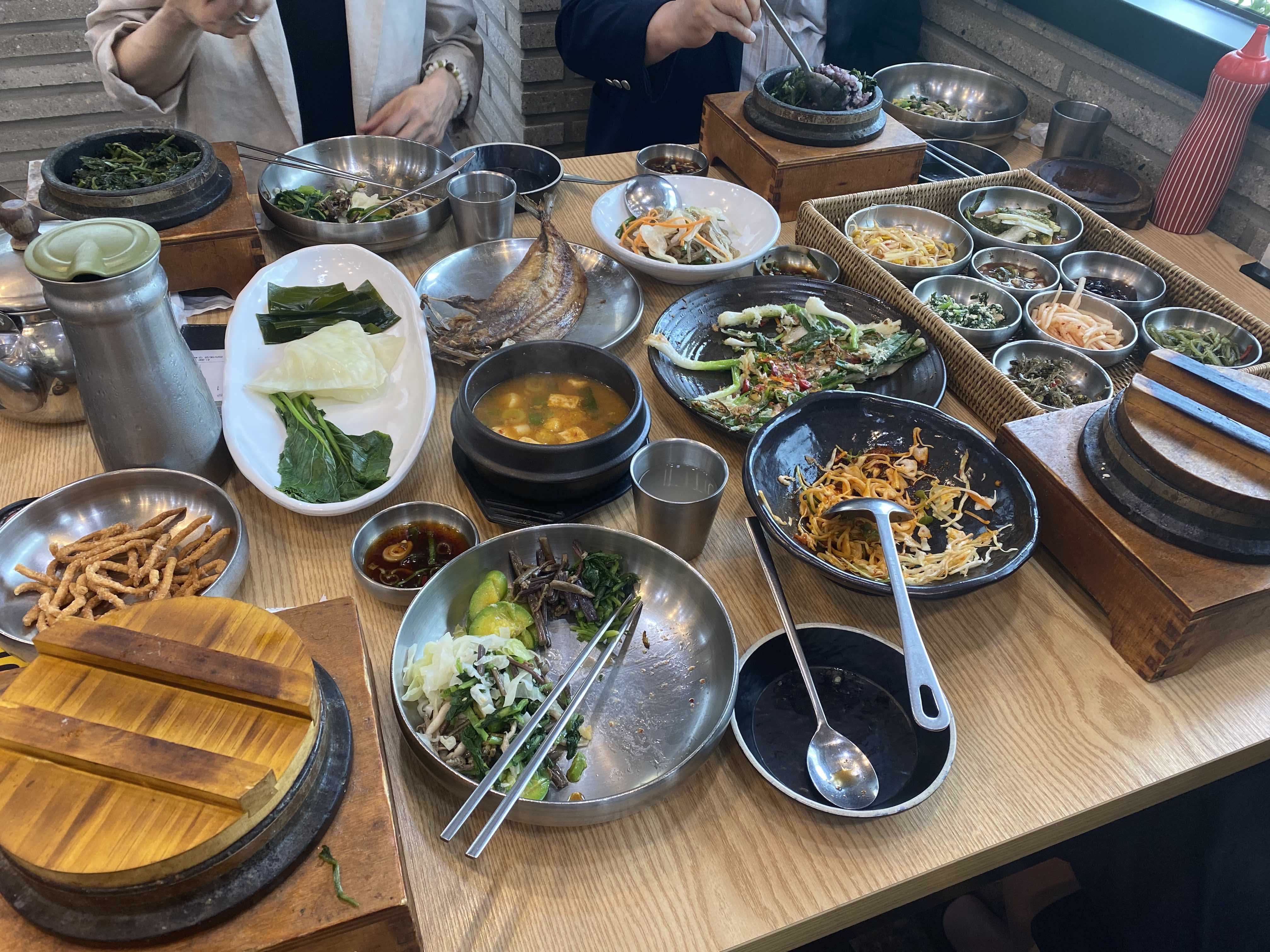
I’ll write more about my Korea trip after it’s over, so for now: one snapshot from Daegu, of the lunch spread four of us shared earlier today at a local farm-to-table restaurant. The logistics of handling lunch conversation perfectly encapsulate the kind of good-natured chaos involved in an international conference. Two of my companions speak Korean and English. The local professor who hosted us speaks Chinese and Korean. I speak Chinese and English. So no one fully knew what was being discussed 100% of the time, but we had a lively—and delicious—meal nonetheless.
 Maura Elizabeth Cunningham
Leave a comment