The theme for this week’s collection of links is summer.
Readers who follow me on Instagram have probably noticed that between April and October, most of my weekends involve 5K, 10K, and even half-marathon races. This is a relatively new activity of mine; as I wrote several years ago (in a post that still reliably tops my most-read stats), I grew up with a strong dislike for running. My opinion hasn’t changed—what led me to all those starting lines is the realization that I don’t have to run. Most races, especially in the Midwest, welcome walkers and have more than generous time limits to finish the course. Walker, runner, stroller, whatever … the important thing is to get out and move your body.
This attitude isn’t universal, though, and I appreciate the people who are out there trying to effect change. Latoya Shauntay Snell is one of my favorite Instagram follows for her open and honest discussions of what it’s like to run at the back of the crowd and how to deal with critics. (I don’t get why anyone else cares if someone is moving slowly. As long as the course is safe for everyone, just pay attention to your own pace.) Mirna Valerio organizes inclusive events that emphasize “championing fun and community over finish times.” And Martinus Evans just published The Slow AF Run Club and got profiled in the New York Times. I’m not looking to become a runner, and I certainly don’t expect to win any races with my 15-minute-mile walking pace. But I want to know that I’m as welcome at the finish line as anyone crossing it in a fraction of my time, and I support the work of all organizations making strides [pun intended] toward more inclusive events.
Athletic reporter Brittany Ghiroli takes a close look at the lives and responsibilities of the dozen or so interpreters for Asian baseball players in the United States. “Speaking is only about 10 percent of the job,” Shohei Ohtani’s interpreter explains; other duties include helping the player navigate American life, understand the nuances of locker-room culture, and deal with the ups and downs of an athletic career in an unfamiliar environment. “The most important thing is to be the bridge, a mentor and a friend for them,” a veteran interpreter comments. But they also need to understand the granular details of baseball so they can help the player study data analysis and prepare for games. The full job description is really more like “interpreter, personal assistant, coach, statistician, mediator, and companion.”
Despite their heavy list of responsibilities, those interpreters—and others in the baseball world—have a bit more free time on their hands these days. This is thanks to new rules, designed to speed up the pace of play, that have games running about a half hour faster than last year. I was apprehensive about the rules prior to the season’s start; I thought the new pitch clock would be distracting and prohibitions on infield shifts were unnecessarily rigid.
Now, having watched more than two months of games, I think the changes are great. I don’t at all miss Bryce Harper going through an extensive series of rituals before every swing; I’m thrilled that pitchers are limited in the number of pick-off attempts they can make. As Mark Leibovich writes at The Atlantic, I’m not alone in my endorsement of the new rules—even people who have built careers in baseball had found longer, slower games a test of their commitment to the sport. This year’s adjustments have improved baseball’s tempo while not affecting its fundamental nature.
Now, if only the Phillies were winning those faster games on a more consistent basis.
Like every academic and serious reader I know, I own a lot of unread books. Like … A LOT of unread books. I didn’t mean to let them pile up—it just happened. (And in my [partial] defense, I didn’t buy all of them! Publishers frequently send me books to review.)
This summer, I’m tackling one of my to-be-read shelves through the American Historical Association’s #AHAReads challenge. Using the program’s bingo card to guide my selections, I’m picking out nine books that explore histories of the Black experience in the Americas/United States. I like the idea of approaching my bookshelves with a framework and structure in mind, rather than just randomly hopping from one topic to the next.
The Ann Arbor District Library has also kicked off its summer programming, with the massive Summer Game that got underway yesterday. The amount of planning and organization that goes into this program boggles my mind; in addition to hundreds of challenges and trivia questions on the library’s website, it also involves businesses, locations, and events throughout the city. What I enjoy about the AADL’s game is that it prompts me to visit new places and attend events that might not ordinarily get on my radar. Earlier today, for example, I walked around the Ann Arbor Comic Arts Festival and listened to a talk by graphic artist Nate Powell. Powell did the artwork for John Lewis’s March trilogy—which, I realized, will be a perfect selection for one of the #AHAReads categories. Bingo.
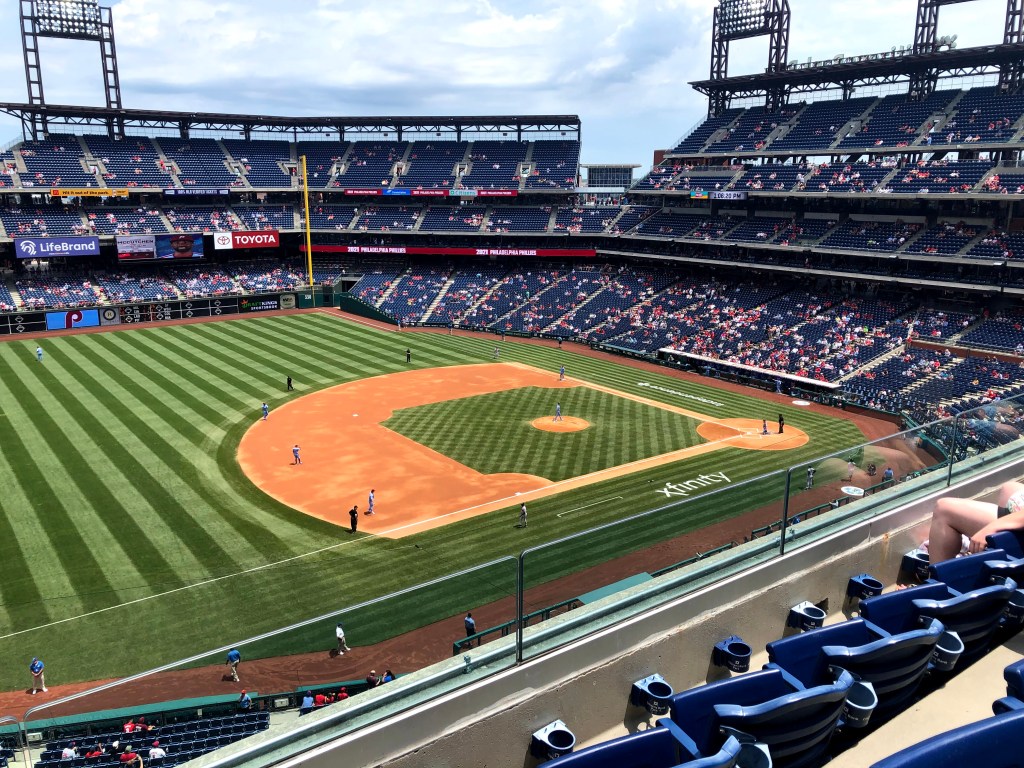
Feature photo: Phillies game at Citizens Bank Park, June 10, 2021.
 Maura Elizabeth Cunningham
Leave a comment